Old Fashioned Push Button Light Switches
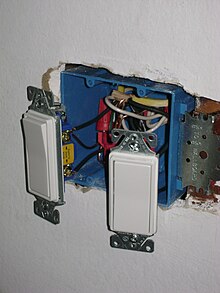
Ii Lutron decorator-style rocker switches and wiring (often called "Decora switches", after the trademarked Leviton switches[ane]), every bit installed in the Usa. Shown hither will exist fastened to this recessed, non-metallic box, and so a cover plate is installed. This "double gang" (ii unit of measurement) installation uses non-metallic-sheathed cable and twist-on wire connectors.
In electrical wiring, a low-cal switch is a switch near unremarkably used to operate electric lights, permanently connected equipment, or electrical outlets. Portable lamps such every bit table lamps may have a low-cal switch mounted on the socket, base, or in-line with the string. Manually operated on/off switches may exist substituted by dimmer switches that allow decision-making the brightness of lamps as well as turning them on or off, time-controlled switches, occupancy-sensing switches, and remotely controlled switches and dimmers. Light switches are also establish in flashlights, vehicles, and other devices.
Wall-mounted switches [edit]
Switches for lighting may be in mitt-held devices, moving vehicles, and buildings. Residential and commercial buildings usually accept wall-mounted light switches to control lighting within a room. Mounting superlative, visibility, and other design factors vary from land to country. The switch mounting boxes, or enclosures are often recessed within a finished wall. Surface mounting of enclosures is also fairly common though is seen more than in commercial industrial and outbuilding settings than in residential structures. These light switch boxes (a pattress box) are designed to firm and mountain the switch(south), protect the wiring and contain any oestrus or burn down. Each kind uses some form of a plastic, ceramic, or metal encompass to preclude adventitious contact with live terminals of the switch. Wall plates are available in different styles and colours to alloy in with the mode of a room, also bachelor in weatherproof varieties for outdoors. These covers are usually quite easy to mount.
History, civilisation, and style [edit]

Two light switches in 1 box. The switch on the right is a dimmer switch. The switch box is covered by a decorative plate.
The beginning calorie-free switch employing "quick-break technology" was invented by John Henry Holmes in 1884 in the Shieldfield district of Newcastle upon Tyne.[two] The "quick-break" switch overcame the problem of a switch'due south contacts developing electric arcing whenever the circuit was opened or closed. Arcing would crusade pitting on ane contact and the build-upwardly of residue on the other, and the switch'south useful life would be macerated. Holmes' invention ensured that the contacts would dissever or come together very quickly, however much or piffling pressure level was exerted by the user on the switch actuator. The activity of this "quick break" mechanism meant that there was bereft time for an arc to class, and the switch would thus take a long working life. This "quick break" technology is nonetheless in utilise in virtually every ordinary light switch in the world today, numbering in the billions, as well every bit in many other forms of electric switch.
The toggle low-cal switch was invented in 1916 by William J. Newton.[3]
As a component of an electrical wiring or dwelling house wiring system, the installation of lite switches is regulated by some authority concerned with safety and standards. In unlike countries the standard dimensions of the wall mounting hardware (boxes, plates, etc.) may differ. Since the face-plates used must cover this hardware, these standards determine the minimum sizes of all wall mounted equipment. Hence, the shape and size of the boxes and face-plates, also as what is integrated, varies from state to state.
The dimensions, mechanical designs, and even the full general appearance of light switches have changed slowly over time. Switches typically remain in service for many decades, often being changed only when a portion of a business firm is rewired. It is not unusual to see century-old light switches even so in functional use. Manufacturers introduce diverse new forms and styles, only for the nigh part decoration and manner concerns are limited to the face-plates or wall-plates. Even the "modernistic" dimmer switch with knob is at least forty years old, and in even the newest construction the familiar toggle and rocker switch formats predominate.
Orientation [edit]
The direction which represents "on" also varies by country. In the U.s., Canada, European countries, Russia, etc., it is usual for the "on" position of a toggle switch to exist "upward", whereas in many other countries such as the UK, India, Australia, New Zealand (Commonwealth countries) and Ireland, information technology is "downwardly". (In multiway switching, the correspondence between a single switch's land and whether lights are on or off depends on the state of the other switch[es] in the circuit.)
Design [edit]
The switches may be single or multiple, designed for indoor or outdoor use. Optional extras may include dimmer-controls, environmental protection, weather and security protection. In residential and light commercial lighting systems, the low-cal switch directly controls the circuit feeding the lamps. In larger lighting systems, for instance warehouses or outdoor lighting systems, the required current may exist too loftier for a transmission switch. In these systems light switches control lighting contactors, a relay that allows the manual lite switch to operate on a lower voltage or with smaller wiring than would be required in the primary lighting circuit.
In the Great britain, putting 13 amp BS 1363 sockets on a lighting circuit is discouraged (although non outright prohibited), but 2 amp or v amp BS 546 outlets are often put on lighting circuits to allow command of free-standing lamps from the room'south lite switches. In Due north American site-built and mobile homes, often living rooms and bedrooms accept a switched receptacle for a floor or table lamp.
Internal operation [edit]
The contacts of a switch are nether their greatest stress while opening or endmost. As the switch is closed, the resistance between the contacts changes from nigh infinite to about zero. At space resistance, no current flows and no power is prodigal. At zero resistance, there is no voltage drop and no ability is dissipated. However, while the contacts modify state, there is a cursory instant of partial contact when resistance is neither zippo nor infinite, and electrical power is converted into oestrus. If the heating is excessive, the contacts may be damaged, or may even weld themselves closed.
A switch should be designed to brand its transition as swiftly as possible. This is achieved past the initial performance of the switch lever machinery storing potential energy, usually every bit mechanical stress in a bound. When sufficient mechanical free energy is stored, the mechanism in the switch "breaks over", and quickly drives the contacts through the transition from open to closed, or airtight to open, without further action past the switch operator. This quick-break activeness of the switch is essential to a long life for the switch contacts, as described in Holmes' 1884 patent.
While the contacts are separating, whatsoever electric energy stored in the inductance of the circuit being disconnected is dissipated as an arc within the switch, prolonging the transition and worsening the heating effect on the contacts. Switches are commonly rated by the current they are designed to break, under specified voltage and power gene conditions, as this is the nearly stringent limitation.
The arc that results when the switch opens erodes the switch contacts. Therefore, any switch has a finite life, often rated at a given number of cycles of disconnection at a specified current. Functioning outside of its specified operating capacity will drastically shorten the life of the switch.
To combat contact corrosion, a switch is usually designed to have a "wipe" action so that the contacts are cleaned. Big switches may exist designed with a supplemental replaceable contact that closes and opens before the master contact, protecting the main electric current-carrying contacts from clothing due to arcing. The contact area of the switch is constructed of materials that resist corrosion and arcing.
Many higher current switch designs rely on the separation arc to aid in dispersing contact corrosion. A switch designed for high-current high-voltage use may become unreliable if operated at very low currents and depression voltages, considering a non-conductive oxide layer builds upwards without an arc to disperse it.
Two kinds of sparks may occur during switch functioning. On closure, a few sparks, like those from a flintstone-and-steel, may appear as a tiny chip of metal is heated past friction to incandescence, melted, and thrown off. On opening, a blue arc may occur, with a detectable "electric" (ozone) odor. Subsequently, the contacts may be seen to exist darkened and pitted. Damaged contacts take higher resistance, rendering them more vulnerable to further impairment and causing a bike in which the contacts shortly may neglect completely.
To make a switch condom, durable, and reliable, it must be designed and then that the contacts are held firmly together under positive strength when the switch is airtight. Information technology should exist designed so that, regardless of how the operator manipulates the actuator, the contacts ever shut or open rapidly.
In the construction of many minor switches, the spring that stores the mechanical free energy necessary for the snap action of the switch mechanism is fabricated of a beryllium copper alloy that is hardened to form a spring as part of the fabrication of the contact. The aforementioned office often likewise forms the torso of the contact itself, and is thus the current path. Abusing the switch machinery to hold the contacts in a transition state, or severely overloading the switch, will oestrus and thus anneal the jump, reducing or eliminating the "snap action" of the switch, leading to slower transitions, more energy dissipated in the switch, and progressive failure.
Variations on design [edit]
Push push [edit]
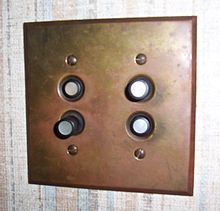
Vintage button-push button light switches
The button-button light switch has 2 buttons: one that closes the contacts and one that opens the contacts. Pushing the raised button opens or closes the contacts and pops out the previously depressed button so the procedure can be reversed. In the U.S., the buttons were usually blackness; the "on" button typically had a white mother-of-pearl (existent or simulated) inlay to indicate its office. Past convention, the switch was customarily installed with the "on" button on top. Push-button switch reproductions are available on the market place today for vintage or authentic styling.
Toggle [edit]


Internal components of a toggle switch
The toggle mechanism provides "snap-activeness" through the utilise of an "over-center" geometry. The design was patented in 1916 past William J. Newton and Morris Goldberg.[3] The switch actuator does non command the contacts directly, merely through an intermediate arrangement of springs and levers. Turning the actuator does not initially cause any motion of the contacts, which in fact proceed to be positively held open past the force of the jump. Turning the actuator gradually stretches the spring. When the mechanism passes over the center point, the bound energy is released and the bound, rather than the actuator, drives the contacts speedily and forcibly to the airtight position with an aural "snapping" audio. This machinery is safe, reliable, and durable, only produces a loud snap or click.
Every bit of 1984[update] in the United States, the toggle switch machinery was almost entirely supplanted by "quiet switch" mechanisms. "Repose switch" mechanisms still possess a class of snap action, only it is very weak as compared to its predecessor. They are therefore equipped with larger, high-quality contacts that are capable of switching domestic loads without damage, despite the less-positive activeness.[ citation needed ]
Illuminated switch [edit]

A UK illuminated rocker switch in the off position
Illuminated switches incorporate a minor neon lamp or LED, assuasive the user easily to locate the switch in the dark. Household illuminated switches were introduced in the mid-1950s.[four]
Unmarried-pole illuminated switches derive the power to energize their in-built illuminating source (usually, a "neon" lamp) from the current passing through the lamp(s) which they control. Such switches work satisfactorily with incandescent lamps, halogen lighting, and non-electronic fluorescent fixtures, because the small electric current required for the switch's illuminating source is as well small to produce whatever visible low-cal from such devices controlled by the illuminated switch. Still, if they control just compact fluorescent lamps (CFLs) and/or LED lamps, the modest corporeality of current required to energize the lighting source inside switch also slowly charges the internal input capacitor in the electronic ballast of the CFL or LED until the voltage across it rises to the bespeak where information technology produces a brief discharge through the CFL. This cycle may echo indefinitely, resulting in repetitive cursory flashing of the lamp(southward) (and the low-cal within the switch) while the illuminated switch is in the "off" position.
Rocker [edit]


A European style rocker switch
An alternative design to the toggle switch is the rocker switch. Large switches of this design are unremarkably known in the United states as "decorator" or "Decora" style.[v] [vi] "Decora" is a trademark of Leviton, and the term in recent years has get a genericized trademark in the United States for any rocker light switch regardless of make. Switches of this design sit almost flush with the wall plate, and are activated by "rocking" a apartment, broad lever, rather than pushing a short protruding actuator up or downward.
In Europe, Hong Kong, Malaysia, Singapore, and India this type is near-universal, and toggle manner switches would exist considered old-fashioned.[ according to whom? ]
Australian rocker switches [edit]

3 Australian light switches and a "neon" indicator—in a iv-gang wall-plate. The lower switch is in the "on" or "down" position.

Ii Australian rocker switches (disassembled), together with a cutaway view, and a view of the switch connections

An Australian architrave-mounted 2-gang switch plate and switches.
In Commonwealth of australia and New Zealand, a small rocker switch is almost universally used, in the form of a 16 mm (0.63 in) switch mechanism, which is mounted from backside into a wall-plate—attaching via mounting lugs, as shown in the photo on the left. A slightly larger "cover plate", supplied with the wall-plate, or additional to it, then clips over the assembly, equally an additional insulating barrier covering the deep set wall-plate mounting screws - which are "deep set" to forestall inadvertent human contact. The "embrace plate" tin can be removed without the use of tools, such as when wall painting is required.
While larger "decorator" style switches are readily available in Australia, the reward of the smaller mechanisms is that wall-plates are available to mountain from one to six individual switch mechanisms, or other correspondingly sized "mechanisms" - such every bit dimmers and indicator lights - in the same infinite every bit one (or two) switches of larger design could be mounted. Since the mechanisms are small, they can also be mounted into "architrave" plates, for mounting in positions where it is non possible to mount a "standard" sized wall-plate. An instance is shown in the picture below on the right. All of the switch mechanisms take no exposed metal parts requiring grounding (earthing). While switches, wall-plates, and cover plates from different manufacturers tend not to be interchangeable, switch mechanisms of this type take been available in Australia since 1951.[7]
The keystone module system for extra-low voltage electric jacks (patented in 1975) is somewhat similar in appearance to these modules, only the design of the keystone mountings are different, and keystone modules can exist removed without a tool. (A similar system, just with bigger switches, is used in Italy.)
Equally shown in the disassembly photograph, the switch actuator pivots in 2 holes in the sides of the plastic switch torso. An actuator bar slides in 2 grooves inside the actuator, pressed down by a compression bound into a notch in the common contact bar. The common contact bar is complimentary to rock on a pocket-sized diameter rod, welded to the common terminal. However, because of the force per unit area practical by the compression spring, the common contact bar volition e'er be held against one of the ii contacts.
When the actuator is moved, mechanical energy is stored in the compression spring until the actuator passes its mid-position. At that time, the common contact bar is forced in the opposite management by the compression bound, acting via the actuator bar, thus breaking the connectedness with the existing contact and making connection with the other contact. The common contact bar is made of copper, with an inlay of harder contact metal on the underside. While it is gratuitous to motility the required distance lengthwise, information technology is constrained from moving sideways by the construction of the molded plastic trunk.
The screw terminals are hollow and allow upward to at least three 1 mm (CSA) wires, twisted together, to be inserted to a depth of up to 10 millimetres (0.39 in) and secured with a set spiral. The contact terminal set up screws are installed at a slight angle to allow easier screwdriver access later the switch machinery has been installed into a wall-plate - before fixing the wall-plate to the wall. Too shown is a "loop" connectedness terminal. This concluding plays no office in the action of the switch but, considering at that place is available space, information technology is provided as an insulated concluding for joining other wires, if required (such as the neutral wires). Each Australian rocker switch mechanism is actually a single-pole, double-throw (SPDT) Switch, also known as a "ii-manner switch", and has 3 terminals.
A switch of basically the aforementioned design is also used on Australian power outlet wall-plates. It is now extremely rare to notice whatever other type of switch in Australian homes, although the Australian Wiring Standard As 3112 does not forbid other types. While many variations of Australian designs and embrace plates are available, some designers and renovators may import UK- and European-designed switches when they desire a detail cease. However, while standard Australian wall mounting plates accept the same dimensions as those used in North America, they have unlike dimensions from those used in the UK or Europe.
Switches (and other mechanisms) of this Australian design serial are currently available in the United kingdom (and other countries), together with wall-plates advisable to the mounting standards of the countries concerned.[8]
For a short time, Australian rocker switches were exported to the United States in the 1960s. Although the switches had adequate ratings for usage on 120 V circuits and had advantages of compactness and distinctive appearance, they failed to establish themselves in the American market.
Tamper resistant [edit]

Tamper resistant switch[ix]
Where lighting circuits must not be accidentally switched off, for example, corridor and restroom lighting controls in public buildings such equally schools, a tamper-resistant switch may be installed. These require a key to operate and so discourage coincidental or adventitious operation of the switch.[x]
Voltage class [edit]
In North American commercial and industrial lighting installations, lighting installed on 480Y/277 V 3-stage circuits uses voltages higher than the rating of common 120 V switches.
Mercury switch [edit]

Mercury lite switch from General Electrical c. 1960, 120 V 15 A
Around the eye of the 20th century, "quiet" switches were introduced that used mercury to make the connection, avoiding the loud snap fabricated by the bound-loaded toggle switches that were then the norm. Ane grade of mercury lite switch uses a sealed glass vial that is tipped past the toggle lever, causing a drop of liquid metallic mercury to roll from one end to the other, bridging a pair of contacts to complete the circuit. Another style of mercury light switch uses a metal cycle with an insulator separating the ii halves that has a pigsty which allows the mercury to connect either side of the wheel in only one position.[eleven]
Some of these switches were also equipped with a neon lamp connected across the contacts, and thus in serial with the electrical load. This caused the indicator to glow faintly when the switch was off, every bit an aid to finding the switch in a dark room.
Past the 1970s, other quiet switch designs that did not require mercury (and were thus simpler and cheaper to produce) came into widespread use, gradually replacing both conventional "snap" toggle switches and mercury-based placidity switches.
Pull-chain or pull-cord [edit]
A light switch combined with a light socket is sometimes installed in basement or utility areas of homes. The switch is operated by a pull chain or string. It is also possible to have the string-operated switch separate from the lite socket, which is specially common in British bathrooms. Until 2001, U.k. wiring regulations required that all bathroom switches were operated past pull cords.
Dimmer switch [edit]
A dimmer switch, properly called a dimmer control, contains a solid-country circuit to allow irresolute the brightness by reducing the average voltage applied to the lamp.
Electronic switches [edit]

In principle, it is easy to design silent switches in which the mechanical contacts do not straight control the current, just simply bespeak a solid-country device such as a thyristor to complete the circuit. Many variations on this theme accept been created and marketed. "Affect-plate" devices tin be operated by touching or merely waving a mitt nigh the switch. Touch on switches have no moving parts and electronically switch the light excursion. As of 1986[update] these remain specialty items. Electronic switches provide flexibility in terms of different interfaces for their operations, such as touch plates, soft-touch controls, pressure or low-cal sensor based command, interactive touch-screens (which are widely used in aircraft for lighting control), and others.
Public buildings such as hospitals oftentimes save energy past using motion detector switches, also known equally occupancy sensors. The occupancy sensors can also exist used in residential applications such as in bathrooms, garages, and hallways.[13]
A wireless lite switch provides remote control of lighting using a manus-held transmitter. While the decision-making device may be a unit dedicated to this purpose, increasingly such switches may be controlled by the engineering (such equally Bluetooth or Wi-Fi) now constitute in smartphones.
Wired remote control of lighting switches is also possible using, for instance, X10 signaling over the power wires.
Multiway switching [edit]
Two or more than light switches tin be interconnected to permit control of lighting from, for example, two ends of a long hallway or landings at the upper and lower landings of a flight of stairs. Multiway switching is washed using special switches that have additional contacts.
Materials [edit]

Old tumbler switch made up of Bakelite
Earlier switches were made of porcelain in the surface-mounted version and operated as a rotary switch with a rotary mechanism. Later, more durable Bakelite and Ebonite was used. Today they are fabricated of modern plastics, like Polycarbonate or burn resistant ABS. Some switches may besides be manufactured from other plastics like polyamide, polypropylene or pvc but mainly limited to wire mounted switches (like night lamp switches) mainly due to reduced weight, and most such switches are not used in high power devices (mainly table lamps, tabular array fans, some radios) mainly up to 2 amperes. In some cases, specially in hospitals and other public facilities, exposed parts of lite switches are fabricated of antimicrobial materials such equally copper, for infection control.
Come across also [edit]
- Touch-sensitive lamp
References [edit]
- ^ www.leviton.com https://www.leviton.com/=Decora®. Retrieved 2018-09-06 .
- ^ Electric Light Years 1878-1899 - England's N East Archived 2015-05-20 at the Wayback Machine
- ^ a b "Affluent Switch" (PDF). Google Patents. Jul 17, 1917. Retrieved 2011-11-11 .
- ^ "What's New for Your Home". Popular Mechanics: 131. March 1955. Archived from the original on 27 May 2013. Retrieved 12 Feb 2013.
- ^ "White Decora Rocker Switch Plates". Kyle Switch Plates . Retrieved 2013-09-xviii .
- ^ "Did you do decora or regular light switches?". GardenWeb Forums . Retrieved 2013-09-18 .
- ^ Clipsal History Timeline Archived 2014-03-07 at the Wayback Car
- ^ "Archived copy" (PDF). Archived from the original (PDF) on 2013-04-eighteen. Retrieved 2014-03-13 .
{{cite web}}: CS1 maint: archived copy equally championship (link) - ^ "Product Message for thirty Amp AC Toggle Switches". Leviton. Retrieved 1 September 2014.
- ^ "Low-Cost Security Measures for School Facilities" (PDF). National Clearinghouse for Educational Facilities. Archived (PDF) from the original on 25 May 2012. Retrieved one September 2014.
- ^ US patent 2101115, Warren R Walker, "Electric switch of the fluid menses type", published 1937-12-07, issued 1937-12-07, assigned to General Electric Vapor Lamp Co
- ^ "How Do Lighting Controls Piece of work?". HeathCo LLC. Archived from the original on thirteen September 2014. Retrieved six November 2018.
- ^ Product Specification for PR150-1L/PR180-1L. Leviton. Retrieved 6 September 2014. [ permanent dead link ]
External links [edit]
-
 Media related to Light switches at Wikimedia Commons
0 Response to "Old Fashioned Push Button Light Switches"
Post a Comment