Halloween Fashion Show at Southern Oregon University
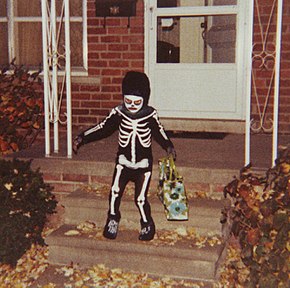
A child dressed equally a skeleton fox-or-treating in Redford, Michigan on October 31, 1979
Trick-or-treating is a traditional Halloween custom for children and adults in some countries. In the evening before All Saints' 24-hour interval (1 November), children in costumes travel from house to business firm, asking for treats with the phrase "Fox or care for". The "treat" is usually some form of candy, although in some cultures money is given instead. The "trick" refers to a threat, commonly idle, to perform mischief on the homeowner(s) or their property if no treat is given. Trick-or-treating usually occurs on the evening of October 31. Some homeowners signal that they are willing to mitt out treats past putting up Halloween decorations exterior their doors; others simply leave treats available on their porches for the children to take freely. Houses may also go out their porch light on as a universal indicator that they take candy.
In Scotland and other parts of Britain and Ireland, the tradition of guising, going firm to house at Halloween and putting on a minor performance to be rewarded with food or treats, goes dorsum at least as far every bit the 16th century, as does the tradition of people wearing costumes at Halloween. There are many accounts from 19th-century Scotland and Ireland of people going house to firm in costume at Halloween, reciting verses in exchange for food, and sometimes warning of misfortune if they were not welcomed.[1] [2] While going business firm to house in costume has long been pop among the Scots and Irish, information technology is only in the 2000s that maxim "Play tricks or care for" has go common in Scotland and Republic of ireland.[3] Prior to this, children in Ireland would commonly say "Help the Halloween Party" at the doors of homeowners.[iii]
In N America, trick-or-treating has been a Halloween tradition since the 1920s. The earliest known occurrence there of the Irish and Scottish Halloween custom of "guising" – children going from house to firm for food or money while bearded in costume[2] – is from 1911, when children were recorded as having done this in Ontario, Canada.[4]
The activity is prevalent in the United Kingdom, Ireland, the U.s.a., Canada, and Australia. In northwestern and central Mexico, this practice is chosen calaverita (Spanish atomic for calavera, "skull" in English), and instead of "Trick or treat", the children enquire, "¿Me da mi calaverita?" ("Can you requite me my niggling skull?"), where a calaverita is a small skull made of sugar or chocolate.
History [edit]
Ancient precursors [edit]
Traditions similar to the mod custom of trick-or-treating extend all the way back to classical antiquity, although it is extremely unlikely that any of them are straight related to the mod custom. The ancient Greek writer Athenaeus of Naucratis records in his book The Deipnosophists that, in ancient times, the Greek island of Rhodes had a custom in which children would go from door-to-door dressed as swallows, singing a vocal, which demanded the owners of the house to requite them food and threatened to cause mischief if the owners of the house refused.[v] [vi] [vii] This tradition was claimed to have been started by the Rhodian lawgiver Cleobulus.[8]
Origins [edit]
Since the Middle Ages, a tradition of mumming on a certain holiday has existed in parts of Uk and Ireland. Information technology involved going door-to-door in costume, performing short scenes or parts of plays in exchange for food or drink. The custom of trick-or-treating on Halloween may come up from the belief that supernatural beings, or the souls of the dead, roamed the earth at this fourth dimension and needed to exist appeased.
It may otherwise accept originated in a Celtic festival, Samhain, held on 31 October–1 November, to mark the starting time of wintertime, in Ireland, Scotland and the Isle of man, and Calan Gaeaf in Wales, Cornwall, and Brittany. The festival is believed to have pre-Christian roots. In the ninth century, the Catholic Church made i November All Saints' 24-hour interval. Among Celtic-speaking peoples, it was seen as a liminal time, when the spirits or fairies (the Aos Sí), and the souls of the dead, came into our world and were appeased with offerings of food and drink. Similar beliefs and customs were found in other parts of Europe. Information technology is suggested that trick-or-treating evolved from a tradition whereby people impersonated the spirits, or the souls of the dead, and received offerings on their behalf. S. V. Peddle suggests they "personify the old spirits of the winter, who demanded reward in commutation for good fortune".[9] Impersonating these spirits or souls was besides believed to protect oneself from them.[10]

"A soul-cake, a soul-block, have mercy on all Christian souls for a soul-cake." — a pop English souling rhyme[11]
At to the lowest degree as far back as the 15th century, among Christians, there had been a custom of sharing soul-cakes at Allhallowtide (Oct 31 through Nov two).[12] [xiii] People would visit houses and take soul-cakes, either equally representatives of the dead, or in return for praying for their souls.[14] Later, people went "from parish to parish at Halloween, begging soul-cakes past singing under the windows some such verse as this: 'Soul, souls, for a soul-cake; Pray y'all good mistress, a soul-cake!'"[15] They typically asked for "mercy on all Christian souls for a soul-block".[16] It was known every bit 'Souling' and was recorded in parts of United kingdom of great britain and northern ireland, Flanders, southern Germany, and Austria.[17] Shakespeare mentions the practice in his one-act The 2 Gentlemen of Verona (1593), when Speed accuses his master of "puling [whimpering or whining] similar a ragamuffin at Hallowmas".[18]
The wearing of costumes, or "guising", at Hallowmas, had been recorded in Scotland in the 16th century[19] and was afterward recorded in other parts of Britain and Ireland.[xx] There are many references to mumming, guising or souling at Halloween in Great britain and Ireland during the late 18th century and the 19th century. In parts of southern Ireland, a man dressed every bit a Láir Bhán (white mare) led youths house to house reciting verses—some of which had pagan overtones—in exchange for food. If the household donated food it could expect good fortune from the 'Muck Olla', but if they refused to practice so, it would bring misfortune.[21] In Scotland, youths went house to business firm in white with masked, painted or blackened faces, reciting rhymes and often threatening to practice mischief if they were not welcomed.[20] [22] [23] In parts of Wales, peasant men went business firm to house dressed as fearsome beings chosen gwrachod, or presenting themselves as the cenhadon y meirw (representatives of the dead).[20] In western England, by and large in the counties bordering Wales, souling was mutual.[thirteen] According to ane 19th century English writer "parties of children, dressed up in fantastic costume […] went round to the farm houses and cottages, singing a song, and begging for cakes (spoken of as "soal-cakes"), apples, money, or annihilation that the goodwives would requite them".[24]

Girl in a Halloween costume in 1928 in Ontario, Canada, the same province where the Scottish Halloween custom of "guising" is first recorded in North America
A contemporary account of guising at Halloween in Scotland is recorded in 1895, where masqueraders in disguise conveying lanterns made out of scooped out turnips, visit homes to exist rewarded with cakes, fruit, and money.[25] The primeval known occurrence of the practice of guising at Halloween in N America is from 1911, when a newspaper in Kingston, Ontario, Canada reported on children going "guising" around the neighborhood.[iv]
American historian and writer Ruth Edna Kelley of Massachusetts wrote the first book length history of the holiday in the U.s.; The Book of Hallowe'en (1919), and references souling in the chapter "Hallowe'en in America"; "The taste in Hallowe'en festivities now is to written report old traditions, and agree a Scotch party, using Burn'southward poem Hallowe'en as a guide; or to get a-souling as the English language used. In short, no custom that was one time honored at Hallowe'en is out of style at present."[26] Kelley lived in Lynn, Massachusetts, a town with 4,500 Irish gaelic immigrants, 1,900 English immigrants, and 700 Scottish immigrants in 1920.[27] In her volume, Kelley touches on customs that arrived from across the Atlantic; "Americans have fostered them, and are making this an occasion something like what it must have been in its best days overseas. All Hallowe'en customs in the U.s. are borrowed straight or adapted from those of other countries".[28]
While the first reference to "guising" in North America occurs in 1911, another reference to ritual begging on Halloween appears, place unknown, in 1915, with a third reference in Chicago in 1920.[29]
The earliest known utilise in impress of the term "trick or care for" appears in 1927, from Blackie, Alberta:
Hallowe'en provided an opportunity for real strenuous fun. No real damage was done except to the atmosphere of some who had to chase for wagon wheels, gates, wagons, barrels, etc., much of which decorated the forepart street. The youthful tormentors were at back door and front enervating edible plunder by the word "trick or treat" to which the inmates gladly responded and sent the robbers away rejoicing.[30]
The thousands of Halloween postcards produced between the start of the 20th century and the 1920s commonly show children but do not depict trick-or-treating.[31] The editor of a collection of over 3,000 vintage Halloween postcards writes, "In that location are cards which mention the custom [of trick-or-treating] or show children in costumes at the doors, merely as far every bit we tin tell they were printed later than the 1920s and more than than likely even the 1930s. Tricksters of various sorts are shown on the early postcards, but not the means of appeasing them".[32]
Trick-or-treating does not seem to have become a widespread practice until the 1930s, with the first U.S. appearance of the term in 1932,[33] and the commencement use in a national publication occurring in 1939.[34]
Behavior similar to trick-or-treating was more than usually associated with Thanksgiving from 1870 (shortly after that holiday'southward formalization) until the 1930s. In New York Metropolis, a Thanksgiving ritual known as Ragamuffin Twenty-four hours involved children dressing up as beggars and asking for treats, which later evolved into dressing up in more diverse costumes.[35] [36] Increasing hostility toward the practice in the 1930s eventually led to the begging aspects being dropped, and past the 1950s, the tradition as a whole had ceased.
Increased popularity [edit]
Nearly all pre-1940 uses of the term "flim-flam-or-treat" are from the U.s.a. and Canada. Play tricks-or-treating spread throughout the United States, stalled only by World War II sugar rationing that began in April, 1942 and lasted until June, 1947.[37] [38]

Mag advertisement in 1962
Early on national attention to trick-or-treating was given in October, 1947 problems of the children's magazines Jack and Jill and Children's Activities,[39] and past Halloween episodes of the network radio programs The Baby Snooks Show in 1946 and The Jack Benny Show and The Adventures of Ozzie and Harriet in 1948.[40] Play a joke on-or-treating was depicted in the Peanuts comic strip in 1951.[41] The custom had become firmly established in popular culture past 1952, when Walt Disney portrayed it in the drawing Trick or Care for, and Ozzie and Harriet were besieged by play a joke on-or-treaters on an episode of their goggle box prove.[42] In 1953 UNICEF commencement conducted a national campaign for children to raise funds for the charity while pull a fast one on-or-treating.[43]
Although some popular histories of Halloween have characterized trick-or-treating as an adult invention to re-channel Halloween activities away from Mischief Night vandalism, in that location are very few records supporting this. Des Moines, Iowa is the only surface area known to have a tape of pull a fast one on-or-treating beingness used to deter crime.[44] Elsewhere, adults, every bit reported in newspapers from the mid-1930s to the mid-1950s, typically saw information technology as a grade of extortion, with reactions ranging from bemused indulgence to anger.[45] As well, as portrayed on radio shows, children would take to explain what play a joke on-or-treating was to puzzled adults, and non the other style around. Sometimes even the children protested: for Halloween 1948, members of the Madison Square Boys Club in New York Metropolis carried a parade banner that read "American Boys Don't Beg."[46] The National Confectioners Association reported in 2005 that 80 percent of adults in the United States planned to give out confectionery to flim-flam-or-treaters,[47] and that 93 percent of children, teenagers, and immature adults planned to become trick-or-treating or participating in other Halloween activities.[48]
Phrase introduction to the UK and Republic of ireland [edit]
Despite the concept of fox-or-treating originating in Britain and Ireland in the class of souling and guising, the use of the term "trick or care for" at the doors of homeowners was not common until the 1980s, with its popularisation in function through the release of the film E.T. [49] Guising requires those going door-to-door to perform a song or poem without any jocular threat,[50] and co-ordinate to one BBC announcer, in the 1980s, "play a trick on or care for" was yet ofttimes viewed as an exotic and not particularly welcome import, with the BBC referring to it as "the Japanese knotweed of festivals" and "making demands with menaces".[51] In Ireland before the phrase "trick or treat" became common in the 2000s, children would say "Help the Halloween Political party".[3] Very frequently, the phrase "trick or treat" is simply said and the revellers are given sweets, with the choice of a play a joke on or a treat having been discarded.
Etiquette [edit]

Two children trick-or-treating on Halloween in Arkansas, U.s.a.
Flim-flam-or-treating typically begins at sunset on October 31. Some municipalities choose other dates.[52] [53] [54] [55] [56] [57] Homeowners wishing to participate sometimes decorate their homes with bogus spider webs, plastic skeletons and jack-o-lanterns.
Local variants [edit]
Guising [edit]

Halloween shop in Derry, Northern Ireland. Halloween masks are called 'faux faces' in Ireland.[58]
In Scotland and Republic of ireland, "guising" – children going from door to door in disguise – is traditional, and a gift in the form of food, coins or "apples or nuts for the Halloween party" (in more recent times chocolate) is given out to the children.[3] [59] [60] The tradition is called "guising" because of the disguises or costumes worn by the children.[2] [61] In the Westward Mid Scots dialect, guising is known equally "galoshans".[62] Halloween masks are referred to as "false faces" in Ireland and Scotland.[58] While guising has been recorded in Scotland in the 16th century, a more contemporary record of guising at Halloween in Scotland is in 1895, where masqueraders in disguise conveying lanterns made out of scooped out turnips, visit homes to be rewarded with cakes, fruit, and money.[25] Guising also involved going to wealthy homes, and in the 1920s, boys went guising at Halloween up to the flush Thorntonhall, S Lanarkshire.[63] An account of guising in the 1950s in Ardrossan, North Ayrshire, records a child receiving 12 shillings and sixpence, having knocked on doors throughout the neighbourhood and performed.[l] In Ireland, children in their masks and costumes would commonly say "Assistance the Halloween Political party" at the doors of homeowners.[iii] [64] Growing up in Derry, Northern Republic of ireland in the 1960s, The Guardian journalist Michael Bradley recalls children asking, "Whatsoever nuts or apples?".[65]
In that location is a significant difference from the fashion the practise has adult in North America with the jocular threat. In Scotland and Ireland, the children are merely supposed to receive treats if they perform a political party trick for the households they get to. This normally takes the form of singing a song or reciting a joke or a funny poem which the kid has memorised before setting out.[fifty] [59] While going from door to door in disguise has remained popular among Scots and Irish at Halloween, the Due north American saying "fob-or-treat" has go mutual in the 2000s.[three] [64]
Trunk-or-treat [edit]
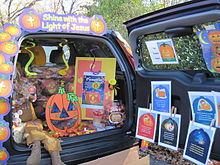
Trunk-or-treating result held at St. John Lutheran Church building & Early on Learning Eye in Darien, Illinois
Some organizations around the United States and Canada sponsor a "body-or-treat" on Halloween night (or on occasion, a mean solar day immediately preceding Halloween or a few days from information technology on a weekend, depending on what is convenient), where trick-or-treating is washed from parked car to parked automobile in a local parking lot, often at a school or church building. This almanac outcome began in the mid-1990s as a "autumn festival" for an culling to play a joke on-or-treating, merely became "trunk-or-treat" 2 decades later. The action involves the open trunk of a car, displaying processed, and often games and decorations. Some parents regard trunk-or-treating as a safer alternative to play tricks-or-treating;[66] while other parents encounter it as an easier alternative to walking the neighborhood with their children. Some have called for more city or community group-sponsored torso-or-treats, and then they can be more than inclusive.[67] These have go increasingly popular in recent years.[68]
Other [edit]
Children of the St. Louis, Missouri area are expected to perform a joke, usually a simple Halloween-themed pun or riddle, earlier receiving any processed; this "play a trick on" earns the "treat".[69] Children in Des Moines, Iowa as well tell jokes or otherwise perform earlier receiving their treat.
In most areas where fox-or-treating is practiced, it is considered an activity for children. Some jurisdictions in the The states forbid the activeness for over-12s.[70] Dressing up is common at all ages; adults will often clothes up to accompany their children, and young adults may clothes up to get out and ask for gifts for a charity.
In some parts of Canada, children sometimes say "Halloween apples" instead of "trick or care for". This probably originated when the toffee apple was a popular blazon of processed. Apple-giving in much of Canada, notwithstanding, has been taboo since the 1960s when stories (of virtually certainly questionable authenticity) appeared of razors hidden inside Halloween apples; parents began to check over their children's fruit for prophylactic before allowing them to eat information technology. In Quebec, children also go door to door on Halloween. However, in French-speaking neighbourhoods, instead of "Trick or treat", they will simply say "Halloween", though it traditionally used to be "La charité, s'il-vous-plaît" ("Charity, delight").[71]
In Portugal, children go from firm to house in All Saints 24-hour interval and All Souls Day, carrying pumpkin carved lanterns called coca,[72] asking everyone they see for Pão-por-Deus singing rhymes where they remind people why they are begging, proverb "...It is for me and for y'all, and to give to the deceased who are dead and buried"[73] or "It is to share with your deceased"[74] In the Azores the bread given to the children takes the shape of the top of a skull.[75] The tradition of pão-por-Deus was already recorded in the 15th century.[76]
In Sweden, children dress up equally witches and monsters when they go trick-or-treating on Maundy Th (the Thursday before Easter) while Danish children dress upwards in various attires and go trick-or-treating on Fastelavn (or the side by side twenty-four hour period, Shrove Monday). In Norway, the practice is quite common amongst children, who come dressed up to people's doors request for, mainly, candy. The Easter witch tradition is done on Palm Sunday in Finland (virvonta).
In parts of Flemish region, some parts of holland and most areas of Germany, Switzerland, and Austria, children go to houses with dwelling house-made beet lanterns or with newspaper lanterns (which can agree a candle or electronic light), singing songs about St. Martin on St. Martin's Day (the 11th of November), in return for treats.[77] In Northern Germany and Southern Denmark, children dress up in costumes and become trick-or-treating on New year's day'due south Eve in a tradition chosen "Rummelpott [de]".[78]
Trick or Treat for Charity [edit]
UNICEF started a program in 1950 called Trick-or-Care for for UNICEF in which trick-or-treaters ask people to give money for the organisation, usually instead of collecting candy. Participating trick-or-treaters say when they knock at doors "Play a joke on-or-care for for UNICEF!"[79] This program started as an alternative to candy. The organization has long produced dispensable collection boxes that state on the back what the money tin can be used for in developing countries.
In Canada, students from the local loftier schools, colleges, and universities clothes up to collect nutrient donations for the local Food Banks every bit a form of trick-or-treating. This is sometimes chosen "Fob-or-Eat".[80]
Run into likewise [edit]
- Sweetest Day
- Poisoned candy myths
- Samhain
- Hop-tu-Naa
- Koledovanie
- Virvonta
- Ben Cooper, Inc.
References [edit]
- ^ Roger, Tricking (2003). Halloween: From Pagan Ritual to Party Nighttime. Oxford University Press. pp. 28–30. ISBN0-19-514691-3.
- ^ a b c "Definition of "guising"". Collins English Dictionary.
(in Scotland and Due north England) the practice or custom of disguising oneself in fancy dress, often with a mask, and visiting people'south houses, esp at Halloween
- ^ a b c d e f "Ten play a joke on-or-treating facts for impressive bonfire chats". The Irish gaelic Times. 31 October 2014.
Scotland and Ireland started tricking: A few decades afterwards a practice called 'guising' was in full swing in Scotland and Ireland. Brusque for 'disguising', children would go out from door to door dressed in costume and rather than pledging to pray, they would tell a joke, sing a vocal or perform another sort of "trick" in exchange for food or money. The expression play tricks or treat has only been used at front doors for the final 10 to 15 years. Before that "Assistance the Halloween Political party" seems to accept been the most popular phrase to holler.
- ^ a b Rogers, Nicholas (2002). "Coming Over: Halloween in North America". Halloween: From Pagan Ritual to Party Night. Oxford University Press. p. 76. ISBN 0-xix-514691-three.
- ^ Turner, Angela (2015). Consume. London: Reaktion Books Ltd. p. unpaginated. ISBN9781780235592.
- ^ Mathiesen, Thomas J. (1999). Apollo's Lyre: Greek Music and Music Theory in Artifact and the Eye Ages . Lincoln: Academy of Nebraska Press. p. 156. ISBN978-1597407960.
swallow song of Rhodes.
- ^ Athenaeus. Deipnosophists 8.360b-d.
- ^ Dalby, Andrew (1998). "Homer's Enemies: Lyric and Epic in the Seventh Century". In Fisher, Nick; van Wees, Hans (eds.). Archaic Greece: New Approaches and New Show. London: Full general Duckworth & Co. Ltd. p. 204. ISBN978-i-910589-58-8.
- ^ Peddle, South. 5. (2007). Pagan Channel Islands: Europe's Hidden Heritage. p. 54
- ^ British Folk Customs, Christina Hole (1976), p. 91
- ^ Hall, Anna Maria (1847). Sharpe's London Magazine. p. 12.
Aubrey relates that, in his time, in Shropshire, &c., in that location was set upon the board a loftier heap of soul-cakes, lying one upon another like the motion picture of the shewbread in the old Bibles. They were about the bigness of twopenny cakes, and every visitant on the banquet of All Souls took one. He adds, "At that place is an old rhyme or saying, 'A soul-cake, a soul-cake, have mercy on all Christian souls for a soul-block.'"
- ^ Jackson, Jeanne Fifty. (1995). Red Letter of the alphabet Days: The Christian Year in Story for Primary Associates. Nelson Thornes. p. 158. ISBN9780748719341.
Afterwards, information technology became the custom for poorer Christians to offer prayers for the dead, in render for money or food (soul cakes) from their wealthier neighbours. People would go 'souling' – rather like carol singing – requesting alms or soul cakes: 'A soul, a soul, a soul cake, Please to requite usa a soul cake, 1 for Peter, 2 for Paul, have mercy on u.s.a. Christians all.'
- ^ a b Hutton, pp. 374–375
- ^ Cleene, Marcel. Compendium of Symbolic and Ritual Plants in Europe. Man & Culture, 2002. p. 108. Quote: "Soul cakes were pocket-sized cakes baked as food for the deceased or offered for the salvation of their souls. They were therefore offered at funerals and feasts of the dead, laid on graves, or given to the poor equally representatives of the dead. The baking of these soul cakes is a universal practice".
- ^ Mary Mapes Dodge, ed. (1883). St. Nicholas Magazine. Scribner & Company. p. 93.
Soul-cakes," which the rich gave to the poor at the Halloween season, in return for which the recipients prayed for the souls of the givers and their friends. And this custom became so favored in popular esteem that, for a long time, it was a regular observance in the land towns of England for pocket-size companies to get from parish to parish at Halloween, begging soul-cakes by singing under the windows some such verse as this: "Soul, souls, for a soul-cake; Pray y'all good mistress, a soul-cake!"
- ^ Santino, Jack (1994). Halloween and Other Festivals of Death and Life. University of Tennessee Press. p. 84. ISBN9780870498138 . Retrieved 28 October 2015.
The begging ritual, taken upward by nonindigents and by children, involved the recitation of a souling rhyme, which typically requested "mercy on all Christian souls for a soul cake."
- ^ Miles, Cloudless A. (1912). Christmas in Ritual and Tradition. Affiliate 7: All Hallow Tide to Martinmas.
- ^ The Two Gentlemen of Verona. Act 2, Scene ane.
- ^ McNeill, F. Marian. Hallowe'en: its origin, rites and ceremonies in the Scottish tradition. Albyn Press, 1970. pp. 29–31
- ^ a b c Hutton, pp. 379–383
- ^ Periodical of the Royal Lodge of Antiquaries of Republic of ireland, Volume 2. 1855. pp. 308–309
- ^ Campbell, Oliver Frances (1900, 1902, 2005) The Gaelic Otherworld. Edited by Ronald Black. Birlinn Ltd. ISBN 1-84158-207-7 pp. 559–562
- ^ Arnold, Bettina (2001-10-31). "Halloween Customs in the Celtic World". University of Wisconsin-Milwaukee. Archived from the original on 2011-06-24. Retrieved 2007-10-xvi .
- ^ Publications, Volume xvi (English Dialect Society), Harvard University Press, p. 507
- ^ a b Leslie, Frank (November 1895). Frank Leslie'southward popular monthly, Volume 4. pp. 540–543. Retrieved 2012-10-10 .
- ^ Kelley, Ruth Edna Kelley. The Book of Hallowe'en, Boston: Lothrop, Lee and Shepard Co., 1919, chapter 15, p. 127. "Hallowe'en in America."
- ^ U.S. Census, January i, 1920, Land of Massachusetts, City of Lynn.
- ^ "Kelley, Ruth Edna. Hallowe'en in America".
- ^ Wright, Theo. E., "A Halloween Story," St. Nicholas, October 1915, p. 1144. Mae McGuire Telford, "What Shall We Practice Halloween?" Ladies Habitation Periodical, October 1920, p. 135.
- ^ "'Play a trick on or Treat' Is Demand," Herald (Lethbridge, Alberta), November iv, 1927, p. v, dateline Blackie, Alberta, Canada Nov. three.
- ^ For examples, see the websites Postcard & Greeting Bill of fare Museum: Halloween Gallery, Antiquarian Hallowe'en Postcards, Vintage Halloween Postcards Archived 2008-07-23 at the Wayback Machine, and Morticia'south Morgue Antique Halloween Postcards.
- ^ East-mail from Louise and Gary Carpentier, 29 May 2007, editors of Halloween Postcards Catalog (CD-ROM), G & L Postcards.
- ^ Miller, Marian (31 October 1932). "Halloween Jollity Within Reason Need". The Forenoon Oregonian. p. viii. Quote: "Trick or treat?" the youthful mischief-maker will say tonight, probably, equally he rings the doorbell of a neighbour."
- ^ Moss, Doris Hudson. "A Victim of the Window-Soaping Brigade?" The American Habitation, Nov 1939, p. 48. Moss was a California-based writer.
- ^ Nigro, Carmen (November 23, 2010). "Thanksgiving Ragamuffin Parade". New York Public Library. Retrieved January 6, 2017.
- ^ "Beggar Parades Mark Holiday in City" (PDF). The New York Times. Nov 28, 1947. Retrieved January half-dozen, 2017.
- ^ Morton, Lisa (2012). Trick or Treat a history of halloween. Reaktion Books. p. 64. ISBN9781780231877.
- ^ "One Lump Delight", Time, March 30, 1942. "Decontrolled", Time, June 23, 1947.
- ^ Published in Indianapolis, Indiana and Chicago, Illinois, respectively.
- ^ The Baby Snooks Prove, November 1, 1946, and The Jack Benny Show, Oct 31, 1948, both originating from NBC Radio City in Hollywood; and The Adventures of Ozzie and Harriet, October 31, 1948, originating from CBS Columbia Square in Hollywood.
- ^ "Peanuts Comic Strip on GoComics.com". Comics.com. 2000-02-13. Retrieved 2012-10-10 .
- ^ "Halloween Party," The Adventures of Ozzie & Harriet, Oct. 31, 1952.
- ^ "A Butt of Fun for Halloween Dark," Parents Mag, October 1953, p. 140. "They're Irresolute Halloween from a Pest to a Projection," The Saturday Evening Mail service, October 12, 1957, p. x.
- ^ ""Des Moines Annals Archived 2013-01-21 at archive.today," Jokes fix local Halloween apart , October. 2000.
- ^ Editorial, Spokane Daily Relate, November 6, 1935, p. 4:
- In plainly fact it is directly New York or Chicago "graft" or "noise" in miniature. Certainly it wouldn't be a good idea for youngsters to become in extensively for this kind of petty "blackmail" on any other date than Halloween. Neither law nor public opinion would correspond that.
- As a female parent of ii children I wish to register indignation at the "fox or treat" racket imposed on residents on Hallowe'en night past the youngsters of this city.… This is pure and elementary blackmail and it is a lamentable state of affairs when parents encourage their youngsters to participate in events of this kind.
- The Commissioners and District of Columbia officials should enact a law to prohibit "beggars night" at Hallowe'en. It is making gangsters of children.… If the parents of these children were fined not less than $25 for putting their children out to beg, they would entertain their children at abode.
- I have lived in some 20 other towns and cities and I never saw nor heard of the begging do until about 1936.… The sooner information technology becomes obsolete here the better. I don't listen the tiny children who want to testify off their costumes, but I resent the impudence of the older children.
- Another twelvemonth has rolled around and the nightmare of having to put upwardly with the "trick or treat" idea again fills me with dread.
- ^ Recalled a decade after by Martin Tolchin, "Halloween A Challenge To Parents," The New York Times, October 27, 1958, p. 35.
- ^ Play a joke on-or-treaters can expect Mom or Dad'due south favorites in their bags this year, National Confectioners Association, 2005.
- ^ Fun Facts: Halloween, National Confectioners Association, 2004.
- ^ "Halloween: trick, treat and a full travesty?". The Telegraph. Retrieved 28 October 2020
- ^ a b c Stuart Christie (2002) The cultural and political formation of a west of Scotland "baby-boomer", Volume i pp. 65–66. Retrieved 2010-xi-11
- ^ Coughlan, Sean. "The Japanese knotweed of festivals", BBC News Magazine, 31 Oct 2007.
- ^ "Trick or Treat to remain on Saturday - Portsmouth Daily Times". www.portsmouth-dailytimes.com. 2021-10-26. Retrieved 2021-xi-01 .
- ^ HOGAN, VERSHAL. "Trick-or-treating will be Sabbatum". Ashley News Observer . Retrieved 2021-11-01 .
- ^ KOCO Staff (2021-10-28). "What day are cities in Oklahoma celebrating fob-or-treating?". KOCO . Retrieved 2021-eleven-01 .
- ^ "Sat officially set up for trick-or-treating". The Southwest Times. 2021-x-29. Retrieved 2021-xi-01 .
- ^ "Saturday, Sunday or both? Here's when Northward Alabama communities propose you flim-flam-or-treat". WAAY News . Retrieved 2021-11-01 .
- ^ 2013 Municipal Trick-or-Care for List, Haunted Wisconsin, dated 2013, re-create at archive.org, copy at webcitation.org
- ^ a b "Top x Irish gaelic Halloween traditions and memories y'all may share". Republic of ireland Central. Retrieved 23 October 2018.
- ^ a b Bannatyne, Lesley Pratt (1998) Forerunners to Halloween Pelican Publishing Company. ISBN i-56554-346-7 p. 44
- ^ Rogers, Nicholas. (2002) "Festive Rights:Halloween in the British Isles". Halloween: From Pagan Ritual to Party Nighttime. p. 48. Oxford University Press. ISBN 0-xix-514691-3
- ^ Sarah Carpenter (December 2001). "Scottish Guising: Medieval And Modern Theatre Games". International Periodical of Scottish Theatre. 2 (2). Archived from the original on August ane, 2012. Retrieved 2008-10-06 .
- ^ Galoshans at Hallowe'en / News / Talk of the Towns. Greenock Telegraph. 27 Oct 2009. Retrieved 31 Oct 2011
- ^ John A. Walker (2002) Sergeant Jiggy p. 14. Cosmos Original Productions, 2002
- ^ a b "11 struggles every Irish play a joke on or treater remembers". TheJournal.ie . Retrieved 28 October 2020.
- ^ Bradley, Michael (24 October 2018). "A very Derry Halloween: a funfair of frights, fireworks and parade". The Guardian . Retrieved 25 Oct 2018.
- ^ "Safe Kids Worldwide" (PDF).
- ^ "'Trunk or treat' doesn't include all children", Standard Examiner, Oct. xi, 2010 Archived December nine, 2014, at the Wayback Machine
- ^ "Santos, Fernanda. "Trunk or Care for! Halloween Tailgating Grows", New York Times, October 31, 2006".
- ^ Palazzolo, Joe (October 31, 2014). "Did You Hear the One About Frankenstein'southward Ghoul Friend?". The Wall Street Periodical . Retrieved 14 November 2014.
- ^ ""What's The Age Limit On Trick Or Treating?", CBS Detroit, October thirty, 2011".
- ^ Halloween in Quebec. provincequebec.com
- ^ Manuel de Paiva Boléo, Universidade de Coimbra. Instituto de Estudos Românicos. Revista portuguesa de filologia – Volume 12 – Página 745 – 1963
- ^ "A canção ródia da andorinha" (PDF).
- ^ "Revista dos Açores, Volume i Sociedade Auxiladora das Lettras Açorianas".
- ^ Intermuseus Dezembro 2006 nº seven Direcção Regional da Cultura Archived 2008-03-11 at the Portuguese Web Archive
- ^ "Elucidario das palavras, termos east frases, que em Portugal antigamente se usárão..., Volume 1".
- ^ "St Martin's Day". H2g2.com. 2007-01-13. Retrieved 2012-10-10 .
- ^ Christian Roy Traditional festivals: a multicultural encyclopedia, Volume two
- ^ "The history of trick-or-treat for UNICEF". Retrieved 21 September 2017.
- ^ "Play tricks or Consume: USSU Food Centre brings food to those who need it near". The Sheaf . Retrieved 21 September 2017.
Further reading [edit]
- Borrelli, Christopher. "The rise and fall of trick-or-treating - Due north Shore". Chicago Tribune . Retrieved 5 May 2021.
- Kawash, Samira (9 October 2009). "The First Candy Twenty-four hour period, xiv October 1916". Candy Professor . Retrieved v May 2021.
- Sweetest Day
- "Nation Broad Candy Day," Processed and Water ice Cream July 1916, p. 34
- "Processed 24-hour interval," International Confectioner June 1916, p. 39
- International Confectioner November. 1916, p. 41
- Kelley, Ruth Edna (1919). The Book of Hallowe'en. Boston: Lothrop, Lee & Shepard. ISBN9781470161958. OCLC 1041627791.
Public Domain free download
- Morton, Lisa (2011). The Halloween Encyclopedia (2 ed.). Jefferson, N Carolina: McFarland, Incorporated, Publishers. ISBN9781784022006. OCLC 864825770.
- Morton, Lisa (2012). Fox Or Treat: A History of Halloween. London, Uk: Reaktion Books, Express. ISBN978-1-78914-158-0. OCLC 1089869589.
- Rogers, Nicholas (2002). Halloween: From Heathen Ritual to Party Nighttime. Oxford University Press. ISBN978-0-19-516896-nine. OCLC 1017560275.
- Skal, David J. (2005). Decease Makes a Holiday : a Cultural History of Halloween. Living Sacrifice Book Co. ISBN0756789001. OCLC 877171040.
- Snodgrass, 1000. Benjamin (2010). "The Specter of Sexual activity Offenders on Halloween: Unmasking Cultural, Constitutional, and Criminological Concerns" (PDF). Ohio State Law Journal. Columbus, Ohio: Ohio Land University Moritz College of Law. 71 (2): 417–456. Retrieved v May 2021.
- Truwe, Ben. The Halloween Itemize Collection. Portland, Oregon: Talky Tina Printing, 2003. ISBN 0-9703448-five-6
- Winick, Stephen. "Research Guides: Halloween & Día de Muertos Resources: Introduction". guides.loc.gov. Library of Congress. Retrieved v May 2021.
- "LOC Halloween: Chambers of Mystery Bibliography" (PDF). loc.gov. loc. Retrieved five May 2021.
The Library of Congress' autumn 2017 pop-up exhibit tells the intriguing tale of Halloween and Día de Muertos (24-hour interval of the Dead) through a dazzling range of treasures from across the collections. LOC Halloween: Chambers of Mystery covers the ancient and mysterious traditions backside these autumn holidays through a rich selection of books and archival special collections. Experience the spooky and solemn celebrations through sound and video recordings, prints and photographs, film scores and canvass music, chapbooks, and movie memorabilia.
- "LOC Halloween: Chambers of Mystery Bibliography" (PDF). loc.gov. loc. Retrieved five May 2021.
- "Ancient Halloween Traditions". Campbell House Museum. 27 October 2016. Retrieved 5 May 2021.
- Ben Cooper, Inc.
0 Response to "Halloween Fashion Show at Southern Oregon University"
Post a Comment