Mens Athletic Fashion Avant Mens Fashion 2017

Mode is a form of self-expression and autonomy at a detail period and place and in a specific context, of wear, footwear, lifestyle, accessories, makeup, hairstyle, and body posture.[ane] The term implies a look defined past the fashion industry every bit that which is trending. Everything that is considered fashion is available and popularized past the style system (industry and media).
Due to increased mass-product of commodities and habiliment at lower prices and global reach, sustainability has get an urgent issue among politicians, brands, and consumers.[two] [3]
Definitions [edit]
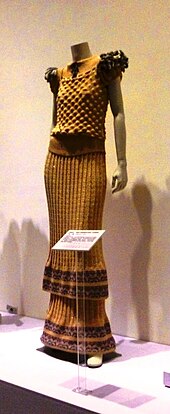
Reconstructed Roman women's way from Florence, Taipei 2013
Mode scholar Susan B. Kaiser states that anybody is "forced to appear", unmediated earlier others.[4] Everyone is evaluated by their attire, and evaluation includes the consideration of colors, materials, silhouette, and how garments announced on the body. Garments identical in way and material also appear unlike depending on the wearer'due south body shape, or whether the garment has been done, folded, mended, or is new.
Fashion is defined in a number of different ways, and its awarding can be sometimes unclear. Though the term style connotes difference, equally in "the new fashions of the flavor", it can also connote sameness, for instance in reference to "the fashions of the 1960s", implying a general uniformity. Fashion can signify the latest trends, but may oft reference fashions of a previous era, leading to the understanding of fashions from a different fourth dimension menses re-actualization. While what is stylish can exist defined past a relatively insular, esteemed and often rich artful elite who make a expect exclusive, such as way houses and haute couturiers, this 'wait' is oft designed past pulling references from subcultures and social groups who are non considered elite, and are thus excluded from making the distinction of what is style themselves.
Whereas a trend often connotes a peculiar artful expression, oftentimes lasting shorter than a season and beingness identifiable by visual extremes, fashion is a distinctive and industry-supported expression traditionally tied to the manner flavor and collections.[5] Way is an expression that lasts over many seasons and is oft connected to cultural movements and social markers, symbols, class, and culture (such every bit Baroque and Rococo). According to sociologist Pierre Bourdieu, manner connotes "the latest difference."[six]
Even though the terms style, clothing and costume are often used together, fashion differs from both. Habiliment describes the material and the technical garment, devoid of any social meaning or connections; costume has come to hateful fancy clothes or masquerade vesture. Style, by contrast, describes the social and temporal system that influences and "activates" dress as a social signifier in a certain fourth dimension and context. Philosopher Giorgio Agamben connects fashion to the qualitative Ancient Greek concept of kairos , pregnant "the right, critical, or opportune moment", and habiliment to the quantitative concept of chronos , the personification of chronological or sequential fourth dimension.[7]
While some exclusive brands may merits the label haute couture, the term is technically limited to members of the Chambre Syndicale de la Haute Couture [viii] in Paris.[v] Haute couture is more than aspirational; inspired past art and culture, and in most cases, reserved for the economical elite.
Fashion is also a source of art, allowing people to display their unique tastes and styling.[9] Different fashion designers are influenced by outside stimuli and reflect this inspiration in their piece of work. For case, Gucci's 'stained light-green' jeans[10] may expect like a grass stain, just to others, they display purity, freshness, and summer.[ane]
Fashion is unique, self-fulfilling and may be a key part of someone'due south identity. Similarly to fine art, the aims of a person's choices in fashion are not necessarily to exist liked past everyone, merely instead to be an expression of personal taste.[ix] A person'south personal fashion functions every bit a "societal formation e'er combining two opposite principles. It is a socially acceptable and secure way to distinguish oneself from others and, at the same fourth dimension, it satisfies the private's need for social adaptation and fake."[11] While philosopher Immanuel Kant believed that fashion "has goose egg to do with genuine judgements of sense of taste", and was instead "a case of unreflected and 'blind' imitation",[11] sociologist Georg Simmel[12] thought of way as something that "helped overcome the distance betwixt an individual and his society".[eleven]
Clothing fashions [edit]

Reconstructed Roman women's fashions from Florence
Fashion is a form of expression. Manner is what people wear in a specific context. If a stranger would appear in this setting, adorning something different, the stranger would be considered "out of fashion."
Early Western[ when? ] travelers who visited India, Persia, Turkey, or China, would frequently remark on the absence of modify in style in those countries. In 1609, the secretary of the Japanese shōgun bragged inaccurately to a Spanish company that Japanese clothing had non changed in over a thou years.[xiii] However, these conceptions of non-Western wear undergoing little, if whatever, evolution are generally held to be untrue; for case, in that location is considerable prove in Ming China of rapidly changing fashions in Chinese habiliment.[xiv] Similar changes in clothing can be seen in Japanese clothing between the Genroku menstruation and the later centuries of the Edo period (1603-1867), during which a time article of clothing trends switched from flashy and expensive displays of wealth to subdued and subverted ones.
Changes in clothing often took place at times of economical or social modify, as occurred in ancient Rome and the medieval Caliphate, followed by a long period without significant changes. In 8th-century Moorish Spain, the musician Ziryab introduced to Córdoba[15] [ unreliable source ] [16] sophisticated clothing styles based on seasonal and daily fashions from his native Baghdad, modified by his inspiration. Similar changes in fashion occurred in the 11th century in the Eye East post-obit the arrival of the Turks, who introduced wearable styles from Central Asia and the Far East.[17]
Additionally, in that location is a long history of fashion in W Africa.[18] Cloth was used as a course of currency in trade with the Portuguese and Dutch as early as the 16th century,[18] and locally-produced cloth and cheaper European imports were assembled into new styles to accommodate the growing elite class of Due west Africans and resident gold and slave traders.[18] There was an uncommonly stiff tradition of weaving in the Oyo Empire, and the areas inhabited past the Igbo people.[18]
Mode in Europe and the Western hemisphere [edit]
The beginning in Europe of continual and increasingly-rapid change in clothing styles can be fairly reliably dated to tardily medieval times. Historians, including James Laver and Fernand Braudel, date the start of Western way in vesture to the center of the 14th century,[19] [twenty] though they tend to rely heavily on contemporary imagery,[21] as illuminated manuscripts were non common before the 14th century.[22] The near dramatic early change in fashion was a sudden desperate shortening and tightening of the male over-garment from dogie-length to barely covering the buttocks,[23] sometimes accompanied with stuffing in the chest to make it look bigger. This created the distinctive Western outline of a tailored elevation worn over leggings or trousers.
The pace of change accelerated considerably in the following century, and women'south and men's mode, specially in the dressing and adorning of the pilus, became as complex. Art historians are, therefore, able to employ fashion with confidence and precision to engagement images, often to inside five years, particularly in the case of images from the 15th century. Initially, changes in mode led to a fragmentation across the upper classes of Europe of what had previously been a very similar style of dressing and the subsequent evolution of distinctive national styles. These national styles remained very different until a counter-motility in the 17th to 18th centuries imposed similar styles once once again, mostly originating from Ancien Régime France.[24] Though the rich ordinarily led fashion, the increasing affluence of early modern Europe led to the bourgeoisie and even peasants following trends at a distance, but still uncomfortably shut for the elites – a gene that Fernand Braudel regards as one of the principal motors of changing fashion.[25]
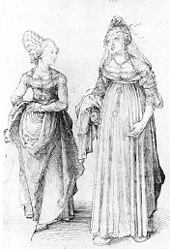
Albrecht Dürer's drawing contrasts a well-turned out bourgeoise from Nuremberg (left) with her counterpart from Venice. The Venetian lady's high chopines make her look taller.
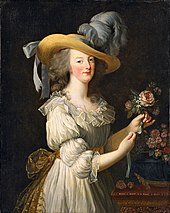
Marie Antoinette, wife of Louis XVI, was a leader of fashion. Her choices, such as this 1783 white muslin dress called a chemise a la Reine , were highly influential and widely worn.[26]
In the 16th century, national differences were at their most pronounced. Ten 16th century portraits of High german or Italian gentlemen may show x entirely dissimilar hats. Albrecht Dürer illustrated the differences in his bodily (or composite) contrast of Nuremberg and Venetian fashions at the shut of the 15th century (illustration, correct). The "Spanish mode" of the belatedly 16th century began the motility back to synchronicity amongst upper-class Europeans, and after a struggle in the mid-17th century, French styles decisively took over leadership, a process completed in the 18th century.[27]
Though different textile colors and patterns changed from year to year,[28] the cut of a gentleman's coat and the length of his waistcoat, or the pattern to which a lady'due south dress was cut, changed more slowly. Men's fashions were primarily derived from military models, and changes in a European male person silhouette were galvanized in theaters of European state of war where gentleman officers had opportunities to brand notes of dissimilar styles such as the "Steinkirk" cravat or necktie. Both parties wore shirts under their clothing, the cut and style of which had little crusade to modify over a number of centuries.
Though in that location had been distribution of dressed dolls from France since the 16th century and Abraham Bosse had produced engravings of fashion in the 1620s, the step of alter picked up in the 1780s with increased publication of French engravings illustrating the latest Paris styles. By 1800, all Western Europeans were dressing alike (or thought they were); local variation became first a sign of provincial culture and later a badge of the conservative peasant.[29]
Although tailors and dressmakers were no doubt responsible for many innovations, and the textile industry indeed led many trends, the history of manner design is mostly understood to date from 1858 when the English-built-in Charles Frederick Worth opened the first authentic haute couture house in Paris. The Haute house was the name established by the authorities for the style houses that met the standards of the manufacture. These mode houses continue to adhere to standards such as keeping at least xx employees engaged in making the clothes, showing ii collections per yr at fashion shows, and presenting a certain number of patterns to costumers.[30] Since then, the thought of the fashion designer as a glory in their ain right has become increasingly dominant.[31]
Although style can be feminine or masculine, boosted trends are androgynous.[32] The idea of unisex dressing originated in the 1960s, when designers such as Pierre Cardin and Rudi Gernreich created garments, such as stretch jersey tunics or leggings, meant to be worn by both males and females. The bear upon of unisex wearability expanded more broadly to encompass diverse themes in manner, including androgyny, mass-market retail, and conceptual clothing.[33] The fashion trends of the 1970s, such equally sheepskin jackets, flight jackets, duffel coats, and unstructured wear, influenced men to attend social gatherings without a dinner jacket and to accessorize in new ways. Some men's styles blended the sensuality and expressiveness, and the growing gay-rights motility and an accent on youth immune for a new freedom to experiment with style and with fabrics such as wool crepe, which had previously been associated with women's attire.[34]

The four major current way capitals are best-selling to be Paris, Milan, New York City, and London, which are all headquarters to the most significant mode companies and are renowned for their major influence on global fashion. Mode weeks are held in these cities, where designers exhibit their new habiliment collections to audiences. A succession of major designers such as Coco Chanel and Yves Saint-Laurent have kept Paris as the center well-nigh watched by the residue of the world, although haute couture is now subsidized by the sale of gear up-to-wear collections and perfume using the same branding.
Modern Westeners have a vast number of choices in the selection of their clothes. What a person chooses to wearable tin can reflect their personality or interests. When people who take high cultural status start to wear new or different styles, they may inspire a new style trend. People who like or respect these people are influenced by their style and begin wearing similarly styled dress.
Fashions may vary considerably within a society according to age, social course, generation, occupation, and geography, and may also vary over time. The terms fashionista and mode victim refer to someone who slavishly follows current fashions.
In the early 2000s, Asian fashion became increasingly significant in local and global markets. Countries such as China, Japan, India, and Pakistan accept traditionally had large textile industries with a number of rich traditions; though these were often fatigued upon by Western designers, Asian clothing styles gained considerable influence in the early- to mid-2000s.[35]
Style manufacture [edit]
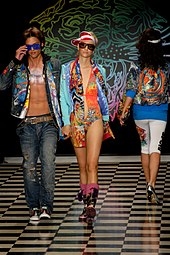
In its most common use, the term manner refers to the current expressions on sale through the fashion industry. The global style industry is a production of the modernistic age.[36] In the Western world, tailoring has since medieval times been controlled by guilds, but with the emergence of industrialism, the power of the guilds was undermined. Before the mid-19th century, well-nigh clothing was custom-made. It was handmade for individuals, either equally dwelling production or on social club from dressmakers and tailors. By the beginning of the 20th century, with the rise of new technologies such every bit the sewing automobile, the ascension of global merchandise, the development of the factory system of production, and the proliferation of retail outlets such equally department stores, clothing became increasingly mass-produced in standard sizes and sold at fixed prices.
Although the manner industry developed showtime in Europe and America, every bit of 2017[update], it is an international and highly globalized manufacture, with habiliment oft designed in ane state, manufactured in some other, and sold worldwide. For case, an American fashion visitor might source cloth in China and have the clothes manufactured in Vietnam, finished in Italy, and shipped to a warehouse in the U.s. for distribution to retail outlets internationally.
The mode manufacture was for a long time one of the largest employers in the United States,[36] and information technology remains so in the 21st century. Notwithstanding, U.South. employment in fashion began to decline considerably as production increasingly moved overseas, especially to China. Because data on the fashion industry typically are reported for national economies and expressed in terms of the industry's many separate sectors, aggregate figures for the globe production of textiles and vesture are difficult to obtain. However, by whatever measure out, the article of clothing industry accounts for a significant share of world economical output.[37] The fashion industry consists of four levels:
- The product of raw materials, principally Cobweb, and textiles but also leather and fur.
- The product of fashion goods by designers, manufacturers, contractors, and others.
- Retail sales.
- Various forms of advertisement and promotion.
The levels of focus in the fashion industry consist of many divide just interdependent sectors. These sectors include Textile Pattern and Production, Manner Design and Manufacturing, Manner Retailing, Marketing and Merchandising, Mode Shows, and Media and Marketing. Each sector is devoted to the goal of satisfying consumer demand for apparel nether conditions that enable participants in the industry to operate at a turn a profit.[36]
Fashion tendency [edit]
A fashion trend signifies a specific wait or expression that is spread across a population at a specific fourth dimension and place. A trend is considered a more ephemeral look, not defined by the seasons when collections are released by the fashion industry. A trend can thus sally from street style, across cultures, from influencers and celebrities.
Fashion trends are influenced by several factors, including cinema, celebrities, climate, creative explorations, innovations, designs, political, economic, social, and technological. Examining these factors is called a PEST assay. Manner forecasters can apply this data to help determine the growth or pass up of a detail tendency.
[edit]


Fashion is inherently a social phenomenon. A person cannot have a fashion by oneself, simply for something to be defined every bit way, there needs to be dissemination and followers. This dissemination tin take several forms; from the peak-down ("trickle-downward") to bottom-up ("chimera up"), or transversally across cultures and through viral memes and media.
Fashion relates to the social and cultural context of an environment. Co-ordinate to Matika,[38] "Elements of popular culture become fused when a person's trend is associated with a preference for a genre of music…similar music, news or literature, fashion has been fused into everyday lives." Fashion is not just seen equally purely aesthetic; fashion is also a medium for people to create an overall outcome and express their opinions and overall art.
This mirrors what performers frequently attain through music videos. In the music video 'Germination' by Beyoncé, according to Carlos,[39] "The popular star pays homage to her Creole roots.... tracing the roots of the Louisiana cultural nerve center from the post-abolition era to nowadays day, Beyoncé catalogs the evolution of the metropolis's vibrant style and its tumultuous history all at once. Atop a New Orleans police force machine in a blood-red-and-white Gucci loftier-collar dress and combat boots, she sits amid the ruins of Hurricane Katrina, immediately implanting herself in the biggest national contend on police force brutality and race relations in modern twenty-four hour period."
The annual or seasonal runway show is a reflection of fashion trends and a designer's inspirations. For designers like Vivienne Westwood, runway shows are a platform for her voice on politics and current events. For her AW15 menswear show, according to H2o,[40] "where models with severely bruised faces channeled eco-warriors on a mission to salve the planet." Another recent example is a staged feminist protest march for Chanel's SS15 bear witness, rioting models chanting words of empowerment with signs similar "Feminist simply feminine" and "Ladies first." According to Water,[twoscore] "The prove tapped into Chanel's long history of championing female person independence: founder Coco Chanel was a trailblazer for liberating the female torso in the post-WWI era, introducing silhouettes that countered the restrictive corsets so in favour."
The annual Academy Awards anniversary is also a venue where fashion designers and their creations are historic.
Social media is likewise a place where mode is presented almost often. Some influencers are paid huge amounts of money to promote a product or clothing item, where the concern hopes many viewers will purchase the product off the back of the advertisement. Instagram is the most popular platform for advertising, merely Facebook, Snapchat, Twitter and other platforms are also used.[41]
Economic influences [edit]
Circular economy [edit]
With increasing environmental awareness, the economic imperative to "Spend now, think later" is getting increasingly scrutinized.[42] Today'due south consumer tends to be more mindful about consumption, looking for just enough and amend, more than durable options. People accept also become more conscious of the bear on their everyday consumption has on the environment and social club, and these initiatives are often described every bit a move towards sustainable fashion, yet critics argue a circular economy based on growth is an oxymoron, or an increasing screw of consumption, rather than a utopian cradle-to-cradle circular solution.
In today's linear economical organization, manufacturers excerpt resources from the earth to make products that will soon be discarded in landfills, on the other paw, under the circular model, the product of appurtenances operates like systems in nature, where the waste and demise of a substance becomes the food and source of growth for something new. Companies such as MUD Jeans, which is based in the netherlands employ a leasing scheme for jeans. This Dutch company "represents a new consuming philosophy that is most using instead of owning," co-ordinate to MUD's website. The concept also protects the company from volatile cotton prices. Consumers pay €7.50 a calendar month for a pair of jeans; after a year, they can render the jeans to Mud, trade them for a new pair and start some other year-long lease, or go on them. MUD is responsible for any repairs during the lease flow.[42] Some other upstanding fashion company, Patagonia set up the outset multi-seller branded store on eBay to facilitate secondhand sales; consumers who take the Mutual Threads pledge can sell in this store and take their gear listed on Patagonia.com's "Used Gear" section.[42]
Red china's domestic spending [edit]
Consumption as a share of gross domestic production in China has fallen for six decades, from 76 per centum in 1952 to 28 percentage in 2011. Cathay plans to reduce tariffs on a number of consumer appurtenances and expand its 72-hour transit visa programme to more cities in an effort to stimulate domestic consumption.[43]
The announcement of import tax reductions follows changes in June 2015, when the authorities cut the tariffs on clothing, cosmetics and various other goods by one-half. Among the changes – easier taxation refunds for overseas shoppers and accelerated openings of more duty-free shops in cities covered by the 72-hour visa scheme. The 72-60 minutes visa was introduced in Beijing and Shanghai in January 2013 and has been extended to 18 Chinese cities.[43]
According to reports at the aforementioned time, Chinese consumer spending in other countries such every bit Japan has slowed even though the yen has dropped.[44] There is clearly a trend in the next five years that the domestic fashion market place volition show an increase.
China is an interesting market place for fashion retail as Chinese consumers' motivation to shop for fashion items are unique from Western Audiences.[45] Demographics have limited association with shopping motivation, with occupation, income and teaching level having no bear on; dissimilar in Western Countries. Chinese high-street shoppers prefer adventure and social shopping, while online shoppers are motivated past idea shopping. Another difference is how gratification and idea shopping influence spending over ¥1k per month on fashion items, and regular spending influenced by value shopping.
Marketing [edit]
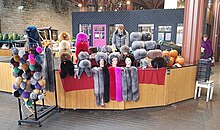
Market research [edit]
Consumers of different groups have varying needs and demands. Factors taken into consideration when thinking of consumers' needs include key demographics.[46] To sympathize consumers' needs and predict fashion trends, fashion companies have to practise market enquiry[47] In that location are 2 research methods: primary and secondary.[48] Secondary methods are taking other data that has already been collected, for case using a volume or an article for research. Primary research is collecting data through surveys, interviews, ascertainment, and/or focus groups. Master research often focuses on large sample sizes to determine customer's motivations to shop.[45]
The benefits of main inquiry are specific information near a mode brand'southward consumer is explored. Surveys are helpful tools; questions can be open up-ended or closed-ended. Negative factor surveys and interviews present is that the answers tin can be biased, due to wording in the survey or on face up-to-face interactions. Focus groups, most 8 to 12 people, can exist benign because several points can be addressed in depth. However, there are drawbacks to this tactic, besides. With such a small sample size, information technology is hard to know if the greater public would react the same way as the focus group.[48] Observation can really assistance a company gain insight on what a consumer truly wants. There is less of a bias considering consumers are just performing their daily tasks, non necessarily realizing they are being observed. For example, observing the public past taking street way photos of people, the consumer did not get dressed in the morning knowing that would have their photograph taken necessarily. They but wear what they would normally wear. Through observation patterns tin can exist seen, helping trend forecasters know what their target market needs and wants.
Knowing the needs of consumers will increase fashion companies' sales and profits. Through research and studying the consumers' lives the needs of the customer can be obtained and assist fashion brands know what trends the consumers are ready for.
Symbolic consumption [edit]
Consumption is driven not only by need, the symbolic pregnant for consumers is also a cistron. Consumers engaging in symbolic consumption may develop a sense of self over an extended period of time as various objects are collected every bit part of the process of establishing their identity and, when the symbolic significant is shared in a social grouping, to communicate their identity to others. For teenagers, consumption plays a role in distinguishing the child self from the adult. Researchers have found that the fashion choices of teenagers are used for self-expression and also to recognize other teens who wear similar apparel. The symbolic clan of clothing items can link individuals' personality and interests, with music as a prominent factor influencing way decisions.[49]
Political influences [edit]

Political figures take played a cardinal part in the development of fashion, at to the lowest degree since the time of French king Louis XIV. For example, First Lady Jacqueline Kennedy was a fashion icon of the early 1960s. Wearing Chanel suits, structural Givenchy shift dresses, and soft color Cassini coats with large buttons, she inspired trends of both elegant formal dressing and archetype feminine style.[fifty]
Cultural upheavals have as well had an impact on style trends. For instance, during the 1960s, the U.S. economy was robust, the divorce rate was increasing, and the authorities canonical the birth control pill. These factors inspired the younger generation to insubordinate against entrenched social norms. The civil rights motility, a struggle for social justice and equal opportunity for Blacks, and the women's liberation movement, seeking equal rights and opportunities and greater personal freedom for women, were in full bloom. In 1964, the leg-baring miniskirt was introduced and became a white-hot trend. Style designers then began to experiment with the shapes of garments: loose sleeveless dresses, micro-minis, flared skirts, and trumpet sleeves. Fluorescent colors, impress patterns, bell-bottom jeans, fringed vests, and skirts became de rigueur outfits of the 1960s.[51]
Concern and protest over U.South involvement in the failing Vietnam War also influenced style . Camouflage patterns in military clothing, developed to help military personnel be less visible to enemy forces, seeped into streetwear designs in the 1960s. Cover-up trends accept disappeared and resurfaced several times since then, appearing in high way iterations in the 1990s.[52] Designers such every bit Valentino, Dior, and Dolce & Gabbana combined camouflage into their runway and prepare-to-clothing collections. Today, variations of cover-up, including pastel shades, in every article of article of clothing or accessory, go on to enjoy popularity.
Engineering influences [edit]
Today, technology plays a sizable role in society, and technological influences are correspondingly increasing within the realm of fashion. Wearable applied science has go incorporated; for instance, clothing constructed with solar panels that charge devices and smart fabrics that heighten wearer condolement by changing color or texture based on ecology changes.[53] 3D printing technology has influenced designers such equally Iris van Herpen and Kimberly Ovitz. Equally the engineering evolves, 3D printers will become more attainable to designers and eventually, consumers — these could potentially reshape pattern and product in the mode manufacture entirely.
Cyberspace engineering science, enabling the far reaches of online retailers and social media platforms, has created previously unimaginable ways for trends to be identified, marketed, and sold immediately.[54] Trend-setting styles are easily displayed and communicated online to attract customers. Posts on Instagram or Facebook can apace increase sensation near new trends in mode, which subsequently may create loftier demand for specific items or brands,[55] new "buy now push" technology can link these styles with direct sales.
Motorcar vision applied science has been developed to runway how fashions spread through society. The industry can at present run into the direct correlation on how fashion shows influence street-chic outfits. Effects such every bit these can now exist quantified and provide valuable feedback to fashion houses, designers, and consumers regarding trends.[56]
Media [edit]

The media plays a pregnant office when it comes to fashion. For case, an important part of fashion is fashion journalism. Editorial critique, guidelines, and commentary can exist establish on television set and in magazines, newspapers, style websites, social networks, and way blogs. In recent years, mode blogging and YouTube videos have become a major outlet for spreading trends and style tips, creating an online culture of sharing one's mode on a website or social media accounts (similar instagram, tiktok, or twitter). Through these media outlets, readers and viewers all over the world can learn well-nigh fashion, making information technology very attainable.[57] In addition to fashion journalism, some other media platform that is important in fashion manufacture is advertisement. Advertisements provide information to audiences and promote the sales of products and services. The fashion industry utilizes advertisements to attract consumers and promote its products to generate sales. A few decades ago when technology was yet underdeveloped, advertisements heavily relied on radio, magazines, billboards, and newspapers.[58] These days, there are more diverse means in advertisements such as television ads, online-based ads using cyberspace websites, and posts, videos, and live streaming in social media platforms.
Mode in printed media [edit]
At that place are two subsets of impress styling: editorial and lifestyle. Editorial styling is the high - fashion styling seen in fashion magazines, and this tends to be more artistic and fashion-forward. Lifestyle styling focuses on a more overtly commercial goal, like a section store advert, a website, or an advertizement where fashion is not what'southward being sold only the models hired to promote the production in the photo.[59]
The dressing practices of the powerful take traditionally been mediated through art and the practices of the courts. The looks of the French courtroom were disseminated through prints from the 16th century on, but gained cohesive blueprint with the development of a centralized courtroom under King Louis XIV, which produced an identifiable style that took his name.[60] At the beginning of the 20th century, fashion magazines began to include photographs of various fashion designs and became fifty-fifty more influential than in the by.[61] In cities throughout the earth these magazines were profoundly sought after and had a profound effect on public taste in vesture. Talented illustrators drew exquisite fashion plates for the publications which covered the most recent developments in fashion and dazzler. Possibly the most famous of these magazines was La Gazette du Bon Ton, which was founded in 1912 past Lucien Vogel and regularly published until 1925 (with the exception of the state of war years).[62]
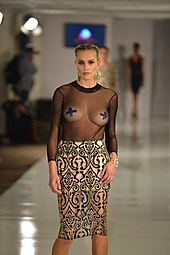
Vogue, founded in the United States in 1892, has been the longest-lasting and well-nigh successful of the hundreds of fashion magazines that have come and gone. Increasing affluence after World War II and, most chiefly, the appearance of cheap color press in the 1960s, led to a huge boost in its sales and heavy coverage of fashion in mainstream women'south magazines, followed by men's magazines in the 1990s. One such instance of Faddy'south popularity is the younger version, Teen Vogue, which covers clothing and trends that are targeted more toward the "fashionista on a budget". Haute couture designers followed the tendency by starting ready-to-wearable and perfume lines which are heavily advertised in the magazines and at present dwarf their original couture businesses. A contempo evolution within fashion print media is the rise of text-based and disquisitional magazines which aim to testify that fashion is not superficial, past creating a dialogue between fashion academia and the manufacture. Examples of this evolution are: Fashion Theory (1997), Mode Exercise: The Journal of Design, Creative Process & the Fashion Industry (2008), and Vestoj (2009).
Fashion in television set [edit]
Television set coverage began in the 1950s with small fashion features. In the 1960s and 1970s, fashion segments on diverse entertainment shows became more frequent, and by the 1980s, dedicated mode shows such as Way Goggle box started to appear. FashionTV was the pioneer in this undertaking and has since grown to become the leader in both Fashion Telly and new media channels. The Fashion Manufacture is kickoff to promote their styles through Bloggers on social media'southward. Vogue specified Chiara Ferragni as "blogger of the moment" due to the rises of followers through her Mode Blog, that became popular.[63]
A few days later on the 2010 Fall Fashion Week in New York City came to a close, The New Islander'due south Fashion Editor, Genevieve Tax, criticized the style manufacture for running on a seasonal schedule of its own, largely at the expense of existent-earth consumers. "Because designers release their fall collections in the spring and their bound collections in the fall, fashion magazines such as Vogue always and only look forward to the upcoming season, promoting parkas come September while issuing reviews on shorts in January", she writes. "Savvy shoppers, consequently, have been conditioned to be extremely, perhaps impractically, farsighted with their buying."[64]
The manner manufacture has been the subject field of numerous films and television shows, including the reality show Project Track and the drama series Ugly Betty. Specific manner brands have been featured in flick, not only as product placement opportunities, but as bespoke items that accept subsequently led to trends in fashion.[65]
Videos in general have been very useful in promoting the fashion manufacture. This is evident not only from television shows directly spotlighting the fashion industry, only also movies, events and music videos which showcase fashion statements as well every bit promote specific brands through production placements.
Controversial advertisements in fashion industry [edit]
Racism in fashion advertisements [edit]
Some fashion advertisements have been accused of racism and led to boycotts from customers. Globally known Swedish manner brand H&M faced this issue with 1 of its children's wear advertisements in 2018. A Black child wearing a hoodie with the slogan "coolest monkey in the jungle" was featured in the ad. This immediately led to controversy, as "monkey" is commonly used as slur confronting Blackness people, and caused many customers to boycott the make. Many people, including celebrities, posted on social media about their resentments towards H&1000 and refusal to work with and buy its products. H&M issued a statement saying "we apologise to anyone this may have offended", though this too received some criticism for actualization insincere.[66]
Another fashion advertisement seen equally racist was from GAP, an American worldwide habiliment brand. GAP collaborated with Ellen DeGeneres in 2016 for the advertizement. It features four playful young girls, with a tall White girl leaning with her arm on a shorter Black daughter's head. Upon release, some viewers harshly criticized it, claiming information technology shows an underlying passive racism. A representative from The Root commented that the ad portrays the message that Black people are undervalued and seen as props for White people to await improve.[67] Others saw little effect with the advertisement, and that the controversy was the effect of people being oversensitive. GAP replaced the epitome in the ad and apologized to critics.[68]
Sexism in mode advertisements [edit]
Many fashion brands have published ads that were provocative and sexy to concenter customers' attention. British loftier fashion brand, Jimmy Choo, was blamed for having sexism in its ad which featured a female British model wearing the brand's boots. In this two-minute ad, men whistle at a model, walking on the street with ruddy, sleeveless mini dress. This ad gained much backlash and criticism past the viewers, equally it was seen every bit promoting sexual harassment and other misconduct. Many people showed their dismay through social media posts, leading Jimmy Choo to pull downwardly the ad from social media platforms.[69]
French luxury fashion brand Yves Saint Laurent as well faced this issue with its print ad shown in Paris in 2017. The ad depicted a female person model wearing fishnet tights with roller-skate stilettos reclining with her legs opened in front of the camera. This ad brought harsh comments from both viewers and French advertising arrangement directors for going confronting the advert codes related to "respect for decency, dignity and those prohibiting submission, violence or dependence, besides every bit the use of stereotypes." and additionally said that this advertisement was causing "mental harm to adolescents."[lxx] Due to the negative public reaction, the affiche was removed from the city.
Public relations and social media [edit]

Fashion public relations involves existence in touch with a company's audiences and creating stiff relationships with them, reaching out to media, and initiating messages that project positive images of the visitor.[71] Social media plays an important office in modern-day fashion public relations; enabling practitioners to reach a wide range of consumers through various platforms.[72]
Building make awareness and credibility is a key implication of proficient public relations. In some cases, the hype is built about new designers' collections before they are released into the market place, due to the immense exposure generated by practitioners.[73] Social media, such equally blogs, microblogs, podcasts, photograph and video sharing sites have all become increasingly important to fashion public relations.[74] The interactive nature of these platforms allows practitioners to engage and communicate with the public in real-time, and tailor their clients' brand or campaign messages to the target audience. With blogging platforms such every bit Instagram, Tumblr, WordPress, Squarespace, and other sharing sites, bloggers have emerged as practiced fashion commentators, shaping brands and having a nifty impact on what is 'on tendency'.[75] Women in the fashion public relations manufacture such as Sweaty Betty PR founder Roxy Jacenko and Oscar de la Renta's PR girl Erika Bearman, have caused copious followers on their social media sites, by providing a brand identity and a backside the scenes look into the companies they piece of work for.
Social media is changing the way practitioners deliver letters,[23] every bit they are concerned with the media, and also customer relationship building.[76] PR practitioners must provide effective advice among all platforms, in lodge to engage the fashion public in an industry socially continued via online shopping.[77] Consumers accept the ability to share their purchases on their personal social media pages (such as Facebook, Twitter, Instagram, etc.), and if practitioners deliver the brand message effectively and see the needs of its public, word-of-oral cavity publicity will be generated and potentially provide a broad reach for the designer and their products.
Manner and political activism [edit]
As fashion concerns people, and signifies social hierarchies, fashion intersects with politics and the social organization of societies. Whereas haute couture and business organization suits are associated by people in power, as well groups aiming to challenge the political order as well use clothes to signal their position. The explicit use of fashion equally a class of activism, is ordinarily referred to as "fashion activism."
There is a circuitous relationship between way and feminism. Some feminists have argued that by participating in feminine fashions women are contributing to maintaining the gender differences which are part of women's oppression.[78] Brownmiller felt that women should reject traditionally feminine dress, focusing on comfort and practicality rather than fashion.[78] Others believe that it is the manner system itself that is repressive in requiring women to seasonally change their clothes to keep upward with trends.[79] Greer has advocated this statement that seasonal changes in dress should be ignored; she argues that women can be liberated past replacing the compulsiveness of fashion with enjoyment of rejecting the norm to create their own personal styling.[lxxx] This rejection of seasonal mode led to many protests in the 1960s alongside rejection of mode on socialist, racial and ecology grounds.[81] Still, Mosmann has pointed out that the relationship between protesting fashion and creating manner is dynamic because the language and manner used in these protests has and so go part of fashion itself.[81]
Fashion designers and brands have traditionally kept themselves out of political conflicts, at that place has been a movement in the industry towards taking more than explicit positions across the political spectrum. From maintaining a rather apolitical stance, designers and brands today engage more explicitly in electric current debates.[82]
For example, considering the U.S.'southward political climate in the surrounding months of the 2016 presidential election, during 2017 fashion weeks in London, Milan, New York, Paris and São Paulo amongst others, many designers took the opportunity to take political stances leveraging their platforms and influence to reach their customers.[83] [84] This has as well led to some controversy over democratic values, as way is non always the about inclusive platform for political debate, just a one-fashion broadcast of top-downward letters.
When taking an explicit political stance, designers mostly favor problems that tin be identified in clear language with virtuous undertones. For instance, aiming to "amplify a greater bulletin of unity, inclusion, diversity, and feminism in a fashion space", designer Mara Hoffman invited the founders of the Women's March on Washington to open her prove which featured modernistic silhouettes of commonsensical wear, described by critics as "Made for a modernistic warrior" and "Habiliment for those who still accept piece of work to practice".[85] Prabal Gurung debuted his collection of T-shirts featuring slogans such as "The Future is Female", "We Will Not Be Silenced", and "Nevertheless She Persisted", with proceeds going to the ACLU, Planned Parenthood, and Gurung's own clemency, "Shikshya Foundation Nepal".[82] Similarly, The Business organisation of Fashion launched the #TiedTogether movement on Social Media, encouraging member of the industry from editors to models, to wear a white bandana advocating for "unity, solidarity, and inclusiveness during manner week".[86]
Mode may be used to promote a cause, such as to promote healthy behavior,[87] to raise money for a cancer cure,[88] or to raise money for local charities[89] such as the Juvenile Protective Clan[90] or a children's hospice.[91]
1 fashion cause is trashion, which is using trash to make dress, jewelry, and other way items in order to promote sensation of pollution. There are a number of modern trashion artists such as Marina DeBris, Ann Wizer,[92] and Nancy Judd.[93] Other designers have used DIY fashions, in the tradition of the punk motion, to address elitism in the manufacture to promote more inclusion and variety.[94]
Anthropological perspective [edit]
From an academic lens, the sporting of various fashions has been seen equally a class of manner linguistic communication, a style of communication that produced diverse manner statements, using a grammar of fashion.[95] This is a perspective promoted in the work of influential French philosopher and semiotician Roland Barthes.
Anthropology, the study of culture and of human being societies, examines fashion by asking why certain styles are deemed socially advisable and others are not. From the theory of interactionism, a sure do or expression is chosen by those in ability in a community, and that becomes "the fashion" every bit defined at a sure time past the people nether influence of those in power. If a detail style has a pregnant in an already occurring prepare of beliefs, then that fashion may have a greater run a risk of become manner.[96]
According to cultural theorists Ted Polhemus and Lynn Procter, one can describe style as adornment, of which at that place are two types: fashion and anti-fashion. Through the capitalization and commoditization of clothing, accessories, and shoes, etc., what one time constituted anti-fashion becomes part of manner as the lines between fashion and anti-style are blurred, as expressions that were one time outside the changes of mode are swept along with trends to signify new meanings.[97] Examples range from how elements from ethnic dress becomes part of a trend and appear on catwalks or street cultures, for case how tattoos travel from sailors, laborers and criminals to popular culture.
To cultural theorist Malcolm Bernard, fashion and anti-fashion differ as polar opposites. Anti-mode is stock-still and changes little over time,[98] varying depending on the cultural or social group 1 is associated with or where one lives, only inside that group or locality the style changes little. Fashion, in contrast, can change (evolve) very quickly[99] and is non affiliated with 1 group or area of the world but spreads throughout the world wherever people can communicate easily with each other. An example of anti-fashion would be ceremonial or otherwise traditional clothing where specific garments and their designs are both reproduced faithfully and with the intent of maintaining a status quo of tradition. This can be seen in the habiliment of some kabuki plays, where some graphic symbol outfits are kept intact from designs of several centuries ago, in some cases retaining the crests of the actors considered to have 'perfected' that part.
Anti-fashion is concerned with maintaining the status quo, while fashion is concerned with social mobility. Time is expressed in terms of continuity in anti-style, and in terms of change in fashion; fashion has changing modes of adornment, while anti-manner has fixed modes of adornment.
From this theoretical lens, change in fashion is part of the larger industrial system and is structured by the powerful actors in this arrangement to exist a deliberate alter in style, promoted through the channels influenced by the industry (such equally paid advertisements).[100]
Intellectual property [edit]
In the fashion industry, intellectual holding is not enforced equally it is inside the film manufacture and music industry. Robert Glariston, an intellectual holding expert, mentioned in a fashion seminar held in LA[ which? ] that "Copyright law regarding clothing is a current hot-button issue in the industry. We oftentimes take to draw the line between designers being inspired by a design and those outright stealing it in dissimilar places."[101] To take inspiration from others' designs contributes to the fashion industry's ability to institute clothing trends. For the by few years, WGSN has been a dominant source of manner news and forecasts in encouraging mode brands worldwide to be inspired by i another. Enticing consumers to buy article of clothing past establishing new trends is, some have argued, a key component of the manufacture's success. Intellectual property rules that interfere with this procedure of trend-making would, in this view, be counter-productive. On the other hand, it is ofttimes argued that the blatant theft of new ideas, unique designs, and pattern details past larger companies is what frequently contributes to the failure of many smaller or independent pattern companies.
Since fakes are distinguishable by their poorer quality, there is still a need for luxury appurtenances, and every bit only a trademark or logo tin can be copyrighted, many fashion brands make this 1 of the about visible aspects of the garment or accessory. In handbags, especially, the designer's brand may exist woven into the textile (or the lining fabric) from which the bag is fabricated, making the brand an intrinsic chemical element of the handbag.
In 2005, the Globe Intellectual Property Arrangement (WIPO) held a conference calling for stricter intellectual property enforcement inside the mode industry to better protect modest and medium businesses and promote competitiveness within the textile and wear industries.[102] [103]
See likewise [edit]
- Digital fashion
- Designer article of clothing
- Dress code
- Mode faux pas
- Mode law
- Fetish fashion
- Fitness fashion
- History of Western fashion
- Human being physical advent
- Index of way articles
- Latex clothing
- Lolita fashion
- Pocket-sized fashion
- Punk fashion
- Cerise carpet manner
- Suit (clothing)
- Sustainable manner
- Western dress codes
- Women's beachwear fashion
References [edit]
- ^ a b KAISER, SUSAN B. (2019). Mode AND CULTURAL STUDIES. BLOOMSBURY VISUAL ARTS. ISBN978-1350109605. OCLC 1057778310.
- ^ "Fixing style: clothing consumption and sustainability". Uk Parliament. 2019.
- ^ Fletcher, Kate (2012). Fashion & sustainability : design for change. Laurence King Pub. ISBN978-1-78067-196-iii. OCLC 866622248.
- ^ Kaiser, Susan (2012). Way and Cultural Studies. London: Berg.
- ^ a b Kawamura, Yuniija. (2005). Fashion-ology : an introduction to mode studies. Berg. ISBN978-1859738146. OCLC 796077256.
- ^ Bourdieu, Pierre (1993). 'Haute couture and haute culture,' in Sociology in Question. Sage.
- ^ Agamben, Georgio (2009). 'What is an apparatus?' and other essays. Stanford Academy Press.
- ^ "Fédération de la Haute Couture et de la Style". Fédération de la Haute Couture et de la Mode . Retrieved 2020-09-19 .
- ^ a b Benton, Angelique (March 2012). "Angelique Benton Style every bit Fine art/ Art as Mode: Is Way, Art?" (PDF). The Ohio State University Journal – via Ohio.
- ^ Dear, Alice (September 2020). "Gucci is selling 'grass-stained' jeans for £600, and people have a lot to say". Eye.
- ^ a b c Gronow, Jukka (1993). "Taste and Fashion: The Social Function of Mode and Mode". Acta Sociologica. 36 (2): 89–xc. doi:x.1177/000169939303600201. JSTOR 4200841. S2CID 56514246. Retrieved x April 2021.
- ^ "Georg Simmel | German sociologist | Britannica".
- ^ Braudel, 312–313
- ^ Timothy Brook: "The Confusions of Pleasure: Commerce and Culture in Ming China" (University of California Printing 1999); this has a whole section on fashion.
- ^ al-Hassani, Woodcok and Saoud (2004), Muslim Heritage in Our Globe, FSTC publishing, pp. 38–39
- ^ Terrasse, H. (1958) 'Islam d'Espagne' une rencontre de 50'Orient et de l'Occident", Librairie Plon, Paris, pp.52–53.
- ^ Josef W. Meri & Jere 50. Bacharach (2006). Medieval Islamic Civilization: A–Yard. Taylor & Francis. p. 162. ISBN978-0415966917.
- ^ a b c d Greenish, Toby, 1974- (2019-03-21). A fistful of shells : Due west Africa from the rise of the slave trade to the age of revolution. Chicago. ISBN9780226644578. OCLC 1051687994.
{{cite book}}: CS1 maint: multiple names: authors listing (link) - ^ Laver, James: The Concise History of Costume and Fashion, Abrams, 1979, p. 62
- ^ Fernand Braudel, Civilization and Capitalism, 15th–18th Centuries, Vol i: The Structures of Everyday Life", p317, William Collins & Sons, London 1981
- ^ Heller, Sarah-Grace (2007). Fashion in Medieval France. Cambridge; Rochester, Due north.Y.: Boydell and Brewer. pp. 49–50. ISBN9781843841104.
- ^ Boitani, Piero (1986-07-31). English Medieval Narrative in the Thirteenth and Fourteenth Centuries. Cambridge Academy Press. ISBN9780521311496.
- ^ a b "Jeans Calças Modelos Ideais". Conceito G. xix Nov 2014. Archived from the original on 19 April 2015. Retrieved 26 April 2015.
- ^ Braudel, 317–324
- ^ Braudel, 313–315
- ^ Ribeiro, Aileen (2003). Dress and Morality. Berg. pp. 116–117. ISBN9781859737828.
- ^ Braudel, 317–321
- ^ Thornton, Peter. Bizarre and Rococo Silks.
- ^ James Laver and Fernand Braudel, op cit
- ^ Claire B. Shaeffer (2001). Couture sewing techniques "Originating in mid- 19th-century Paris with the designs of an Englishman named Charles Frederick Worth, haute couture represents an archaic tradition of creating garments by hand with painstaking intendance and precision". Taunton Press, 2001
- ^ Parkins, Ilya (2013). "Introduction: Reputation, Glory and the "Professional" Designer". Poiret, Dior and Schiaparelli: Manner, Femininity and Modernity (English language ed.). London: Bloomsbury Publishing. p. ten. ISBN9780857853288.
- ^ Undressing Movie theater: Clothing and identity in the movies – Folio 196, Stella Bruzzi – 2012
- ^ "GVRL In Artemis – Document – Unisex Clothing". go.gale.com.
- ^ "GVRL In Artemis – Document – Clothing for Men". go.gale.com.
- ^ Lemire, B., & Riello, K (2008). "E & West: Textiles and Mode in Early Modern Europe". Journal of Social History, 41(4), 887–916.
- ^ a b c "fashion manufacture | Design, Fashion Shows, Marketing, & Facts". Encyclopedia Britannica.
- ^ "How Deal Fashion Chains Volition Keep Themselves Cutting-Rate – New York Magazine". NYMag.com . Retrieved 26 April 2015.
- ^ "Does pop culture influence way?". world wide web.sundaynews.co.zw . Retrieved 2016-03-07 .
- ^ Carlos, Marjon (6 February 2016). "The Fashion in Beyoncé'southward New Video Is as Powerful as Its Politics". Vogue . Retrieved 2016-03-07 .
- ^ a b Dazed (viii Apr 2015). "Vivienne Westwood'due south top x political moments". Dazed . Retrieved 2016-03-07 .
- ^ Wetzler, Tiahn (2020). "Social media influencer marketing". Adjust.
- ^ a b c Vaughn/Berelowitz, Jessica/Marian (2015). "The circular economy". Warc.
- ^ a b Ap, Tiffany (November 2015). "China Makes Moves to Boost Consumption". Women'south Wear Daily.
- ^ Kaiser, Amanda (14 March 2016). "Tokyo Fashion Calendar week Starts in Challenging Economic system". Women's Wear Daily.
- ^ a b Parker, Christopher J.; Wenyu, Lu (2019-05-xiii). "What influences Chinese fashion retail? Shopping motivations, demographics and spending". Journal of Fashion Marketing and Management. 23 (ii): 158–175. doi:x.1108/JFMM-09-2017-0093. ISSN 1361-2026. S2CID 170031856.
- ^ "Consumer Needs & Marketing". smallbusiness.chron.com . Retrieved 2016-05-30 .
- ^ "Strategyn". Strategyn . Retrieved 2016-05-30 .
- ^ a b "Consumer Enquiry Methods". www.consumerpsychologist.com . Retrieved 2016-05-30 .
- ^ Piacentini, Maria (2004). "Symbolic consumption in teenagers' clothing choices". Periodical of Consumer Behaviour. 3 (iii): 251–262. doi:ten.1002/cb.138.
- ^ Rissman, Rebecca (2016-08-xv). Women in Style. ABDO. ISBN9781680774856.
- ^ "Political & Economical Factors That Influenced Way in the 1960s | The Classroom | Synonym". classroom.synonym.com . Retrieved 2016-05-30 .
- ^ "Home : Berg Mode Library". www.bergfashionlibrary.com . Retrieved 2016-03-10 .
- ^ Communications, Edgell. "Top 6 Tech Trends in the Fashion Industry". apparel.edgl.com . Retrieved 2016-03-10 .
- ^ Parker, Christopher J.; Wang, Huchen (2016). "Examining hedonic and commonsensical motivations for m-commerce fashion retail app engagement". Journal of Manner Marketing and Management. 20 (four): 487–506. doi:10.1108/JFMM-02-2016-0015.
- ^ "The Impact of Applied science on Fashion Today". Site Name. Archived from the original on 2016-03-10. Retrieved 2016-03-10 .
- ^ "How Machine Vision Is About to Alter the Mode World". MIT Technology Review . Retrieved 2016-03-10 .
- ^ "Mode". WWD.
- ^ Lauren, Lynn. "Examples of Traditional Advertizing".
- ^ Tran, Shannon (2018). Style Wise. Bloomsbury. p. 6. ISBN9781501323836.
- ^ Burke, Peter (1992). The fabrication of Louis XIV. New Haven: Yale University Press.
- ^ "Fashion Advertising, Sales Promotion, and Public Relations", Marketing Style, Fairchild Publications, 2012, pp. 427–458, doi:10.5040/9781501303869.ch-014, ISBN9781501303869
- ^ "Gazette du Bon Ton: A Periodical of Good Sense of taste". www.abebooks.com . Retrieved 2018-07-04 .
- ^ "How social media is changing fashion?". HuffPost. January xviii, 2017.
- ^ "Tax, Genevieve. (2010-02-24) Fashion's Own Sense of Season. The New Islander. Retrieved on 2011-06-29".
- ^ Thompson, South.B.N., Hussein, Y., Jones, Northward. Designing for the famous – psychology of building a make in haute couture shoe design and fashion. Design Principles & Practices: An International Journal 2011;5(v):i–25.
- ^ "People are boycotting H&M over 'racist' hoodie". The Independent. 2018-01-09. Retrieved 2019-10-29 .
- ^ "Is this Gap advert racist?". 2016-04-06. Retrieved 2019-10-29 .
- ^ Kell, John (2016-04-05). "Gap Apologizes for 'Racist' Ad". Entrepreneur . Retrieved 2019-ten-29 .
- ^ Gallucci, Nicole (22 December 2017). "Jimmy Choo pulls Cara Delevingne advertizement after online backfire". Mashable . Retrieved 2019-10-29 .
- ^ "'Misogynist' YSL Ads Shock Parisians Ahead of International Women's Twenty-four hours". adage.com. 2017-03-07. Retrieved 2019-10-29 .
- ^ Sherman, Thousand., & Perlman, South. (2010). Fashion public relations. New York: Fairchild Books. In Cassidy, Fifty. & Fitch, K. (2013) Beyond the Catwalk: Style Public Relations and Social Media in Commonwealth of australia, Asia Pacific Public Relations Journal, vol. 14, No. i & 2, Murdoch University.
- ^ "How Social Media Contributed to the Rise of Fast Fashion". Retrieved 2018-10-02 .
- ^ Westfield, A. M. (2002) The Function of Public Relations in Redefining Brands in the Way Manufacture, University of Southern California, Los Angeles, California.
- ^ Experian. (2012). Getting the virtually from social: An integrated marketing approach. Retrieved from www.experian.com.au/avails/social/getting-the-most-from-social.pdf in Cassidy, L. & Fitch, G. (2013) Beyond the Catwalk: Fashion Public Relations and Social Media in Australia, Asia Pacific Public Relations Journal, vol. 14, No. i & 2, Murdoch University.
- ^ Dalto, A. (2010, September). Brands tempt female bloggers with 'swag'. O'Dwyer's Communications and New Media: The Fashion Issue, 24(9), 12–thirteen. in Cassidy, L. & Fitch, K. (2013) Beyond the Catwalk: Fashion Public Relations and Social Media in Australia, Asia Pacific Public Relations Journal, vol. 14, No. 1 & 2, Murdoch University.
- ^ Noricks, C. (2006). Social media sites are often the first experience a consumer has with a manner make. From style to strategy: An exploratory investigation of public relations practice in the style industry. Unpublished master'southward thesis, San Diego Land University, San Diego, CA. in Cassidy, L. & Fitch, K. (2013) Beyond the Catwalk: Way Public Relations and Social Media in Australia, Asia Pacific Public Relations Journal, vol. 14, No. one & 2, Murdoch University.
- ^ Wright, M. (2011). How premium fashion brands are maximizing their social media ROI. Mashable. Retrieved from www.mashable.com/2011/02/11/fashion-brands-social-media-roi/ in Cassidy, L. & Fitch, K. (2013) Beyond the Catwalk: Mode Public Relations and Social Media in Australia, Asia Pacific Public Relations Journal, vol. fourteen, No. ane & 2, Murdoch Academy.
- ^ a b Brownmiller, Susan (1984). Femininity. New York: Lindon Press.
- ^ Mosmann, Petra (2016). "A feminist fashion icon: Germaine Greer's paisley coat". Australian Feminist Studies. 31 (87): 87. doi:10.1080/08164649.2016.1174928. S2CID 148120100.
- ^ Greer, Germaine (1971). The Female person Eunuch. London: Paladin.
- ^ a b Mosmann, Petra (2016). "A feminist style icon: Germaine Greer's paisley coat". Australian Feminist Studies. 31 (87): 88. doi:10.1080/08164649.2016.1174928. S2CID 148120100.
- ^ a b "Fashion Week's Anti-Trump Runway Politics". The New Yorker. 21 February 2017.
- ^ "7 Ways Way Joined the Political Chat in 2017". Fashionista . Retrieved 2018-08-16 .
- ^ "Fashion Gets Political: On and Off the Rail Statements". The Hollywood Reporter . Retrieved 2018-08-sixteen .
- ^ "Are style and politics the perfect fit?". BBC News. 15 February 2017.
- ^ "Here'south Why You lot'll See White Bandanas Everywhere During Way Month". InStyle.com.
- ^ "Fashion for a Cause". The Times of Republic of india. 2013-02-04. Archived from the original on 2013-05-01. Retrieved 2013-02-15 .
- ^ Woodman, Anne (2013-01-26). "Fashion for a cause". Clayton News Star. Archived from the original on 2013-04-11. Retrieved 2013-02-fifteen .
- ^ "Mode for a cause". Chatham Daily News. 2013-02-07. Archived from the original on 2013-05-27. Retrieved 2013-02-15 .
- ^ luc, karie angell (2013-01-16). "'Fashion for a Cause' aids families and kids". Northbrook Star. Archived from the original on 2013-06-07. Retrieved 2013-02-15 .
- ^ "Style for a cause". Capital Gazette. Archived from the original on 2013-04-07. Retrieved 2013-02-xv .
- ^ "One human'southward trash is some other man'south fashion". NBC News/ AP. 2008-07-02. Retrieved 2013-02-fifteen .
- ^ Simon, Stephanie (2009-01-13). "Trashion Trend: Dumpster Couture Gets a Boost at Dark-green Inaugural Brawl". Wall Street Journal . Retrieved 2013-02-15 .
- ^ Busch, Otto von (2014). "Manner Hacking". Design as Hereafter-Making. doi:10.5040/9781474293907-0009. ISBN9781474293907.
- ^ Barthes, Roland (1983). The Fashion System. Berkeley: Univ. of California Press.
- ^ Molnar, Andrea K (1998). Transformations in the Use of Traditional Textiles of Ngada (Western Flores, Eastern Indonesia): Commercialization, Fashion and Ethnicity. Consuming Way: Adorning the Transnational Torso: Berg. pp. 39–55 [42].
- ^ Polhemus and Procter, Ted and Lynn (1978). Fashion and Anti-fashion: An Anthropology of Clothing and Beautification. Thames and Hudson. p. 12.
- ^ Barnard, Malcolm (1996). Fashion as advice. London: Routledge.
- ^ Hamilton Hill, Margot; Bucknell, Peter A. (1987). The Evolution of Fashion: Pattern and Cut from 1066 to 1930 (5 ed.). London: Batsford. p. vii. ISBN9780713458183 . Retrieved 20 Nov 2020.
- ^ Polhemus and Procter, Ted and Lynn (1978). Mode and Anti-fashion: An Anthropology of Wearable and Adornment. Thames and Hudson. pp. 12–13.
- ^ "Design details by larger companies is what oft | Outspoken". outspoken.wpshower.com . Retrieved 2018-08-16 .
- ^ IPFrontline.com Archived 2007-05-10 at the Wayback Machine: Intellectual Holding in Fashion Manufacture, WIPO press release, Dec 2, 2005
- ^ INSME announcement Archived 2007-09-29 at the Wayback Machine: WIPO-Italy International Symposium, 30 November – ii December 2005
Bibliography [edit]
- Braudel, Fernand Culture and Commercialism, 15th–18th Centuries, Vol 1: The Structures of Everyday Life, William Collins & Sons, London 1981 ISBN 0-520-08114-five
Further reading [edit]
- Breward, Christopher, The culture of fashion: a new history of fashionable clothes, Manchester: Manchester University Printing, 2003, ISBN 978-0-7190-4125-nine
- Cabrera, Ana, and Lesley Miller. "Genio y Figura. La influencia de la cultura española en la moda." Way Theory: The Journal of Dress, Trunk & Civilization 13.1 (2009): 103–110
- Cumming, Valerie: Understanding Style History, Costume & Fashion Printing, 2004, ISBN 0-89676-253-X
- Hollander, Anne, Seeing through clothes, Berkeley: University of California Press, 1993, ISBN 978-0-520-08231-1
- Hanifie, Sowaibah (5 August 2020). "Australia'due south starting time National Indigenous Fashion Awards winners revealed, signalling hope for a more diverse industry". ABC News. Australian Broadcasting Corporation.
- Hollander, Anne, Sex activity and suits: the evolution of modern wearing apparel, New York: Knopf, 1994, ISBN 978-0-679-43096-4
- Hollander, Anne, Feeding the eye: essays, New York: Farrar, Straus, and Giroux, 1999, ISBN 978-0-374-28201-1
- Hollander, Anne, Fabric of vision: clothes and drapery in painting, London: National Gallery, 2002, ISBN 978-0-300-09419-0
- Kawamura, Yuniya, Fashion-ology: an introduction to Fashion Studies, Oxford and New York: Berg, 2005, ISBN ane-85973-814-1
- Lipovetsky, Gilles (translated by Catherine Porter), The empire of fashion: dressing modern republic, Woodstock: Princeton University Printing, 2002, ISBN 978-0-691-10262-vii
- McDermott, Kathleen, Style for all: why fashion, invented by kings, at present belongs to all of us (An illustrated history), 2010, ISBN 978-0-557-51917-0 – Many paw-drawn colour illustrations, extensive annotated bibliography and reading guide
- Perrot, Philippe (translated by Richard Bienvenu), Fashioning the bourgeoisie: a history of clothing in the nineteenth century, Princeton NJ: Princeton University Press, 1994, ISBN 978-0-691-00081-7
- Steele, Valerie, Paris manner: a cultural history, (2. ed., rev. and updated), Oxford: Berg, 1998, ISBN 978-1-85973-973-0
- Steele, Valerie, Fifty years of manner: new look to now, New Haven: Yale University Press, 2000, ISBN 978-0-300-08738-3
- Steele, Valerie, Encyclopedia of clothing and mode, Detroit: Thomson Gale, 2005
- Davis, F. (1989). Of maids' uniforms and blueish jeans: The drama of condition ambivalences in wear and fashion. Qualitative Sociology, 12(four), 337–355.
0 Response to "Mens Athletic Fashion Avant Mens Fashion 2017"
Post a Comment